
The Disappearance of Margaret Bale
In December 1909, Margaret Bale, a 25-year-old schoolteacher who had spent three years teaching at the Sisters of the Church school at Lamington Heights, Kalgoorlie (now a private House at 26 Ward Street, Lamington), left the goldfields intending to return to England. She travelled to Perth and stayed with friends until December 22—then vanished without a trace. A search was immediately launched. She failed to board her ship from Albany on January 6, and despite months of investigation, no clue to her whereabouts could be found. The case became widely known, and public interest grew as time passed.
Seven months later, the mystery was astonishingly resolved. Margaret Bale reappeared—after having lived all that time disguised as a young man under the name “Martin Able.”
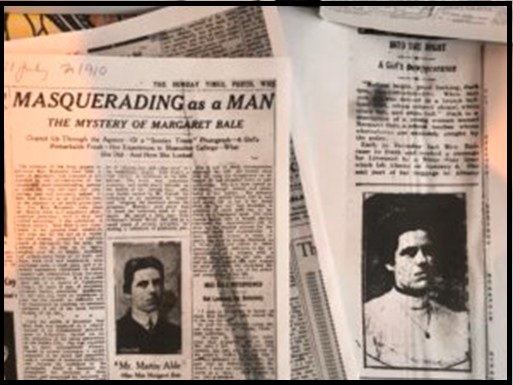
By transposing the letters of her surname, Bale became Able. Cutting her hair short and dressing in male attire, she set out to begin a completely new life. Her motive, she later explained, was a sudden desire to escape the monotony of her previous existence and avoid returning to England. As “Martin Able,” she first took lodgings in Fremantle and secured work as a steward at the Fremantle Club. There, she earned 15 shillings a week and impressed her employers with her neatness and diligence, particularly in tasks requiring care and precision.
However, her refined manners and distaste for coarse language set her apart from other staff.
After leaving the club, she moved through several jobs, including a position as cellarman and handyman at the Oddfellows Hotel, where she remained for three months, though the physical demands proved difficult. She was noted for her meticulous washing and general tidiness. Later, she attempted to run her own small business in Fremantle, selling postcards, photographs, and stationery, but the venture failed. Eventually, she found employment as a clerk in a Perth catering office.
Throughout her time as “Martin Able,” she successfully maintained her disguise—smoking, attending dances, and even attracting the attention of young women, though these situations sometimes caused her embarrassment. Her secret might have remained undiscovered but for a photograph published in the Sunday Times. A shop assistant in Fremantle recognised the resemblance between the missing Margaret Bale and “Martin Able” and alerted the police.
Detectives followed up—and the extraordinary deception came to an end.
Image by Jes Fernie
“When I Was a Man”
Margaret Bale later sold her story to a newspaper and, in her own words, described how her life took such an unexpected turn.
Born in Colchester, England, in 1881, the daughter of Major John Edward Bale, she was well educated and worked as a governess before accepting a three-year teaching position in Kalgoorlie in 1906. Despite initial reluctance and family opposition, she honoured her commitment and travelled to Western Australia. She adapted quickly to life on the goldfields, recalling both the harsh climate and the eccentricities of her superiors with amusement. By late 1909, her term was nearing its end, and she travelled to Perth for the Christmas holidays, with plans to return to England.
It was there, suddenly and without premeditation, that she decided she did not wish to go home. Determined to disappear, she conceived the idea of adopting a disguise. Within hours, she purchased a suit, boots, and a hat, had her hair cut short, and transformed herself into “Martin Able.”
After changing clothes among the sand dunes at Cottesloe, she made her way to Fremantle and began life anew as a young man. She found lodgings, carefully adjusted her manner and speech, and soon realised she must find employment to avoid suspicion. Despite repeated setbacks, she persisted—applying for positions, struggling financially, and living modestly. Eventually, she secured various jobs, though none proved entirely successful. She later reflected on the difficulties of finding work and accommodation, particularly while maintaining her disguise. By mid-1911, she believed the search for her had faded. However, her confidence was shaken when she saw newspaper reports about her own disappearance. Soon after, her landlady also mentioned the case, increasing her unease.
Her discovery came on August 4, 1911, when Detective Dempsey confronted her at her workplace. When challenged, she admitted her identity without resistance. She was taken into custody but cooperated fully, explaining her actions candidly. She promised never again to disguise herself as a man and was released into the care of her friends, who had long believed her dead.

Margaret later stated that her primary motive had been her determination not to return to England at that time. Despite the risks, she described her experiences as both extraordinary and, at times, most enjoyable.
On 25 June 1912, in Port Adelaide, South Australia, she married a divorcee, Arthur Emerson Borkwood. They had three children: Lionel Arthur, born in 1912 in South Australia, Basil Ambrose, born in 1914 and Edwin Harvey, born in 1916, both born in England. Her husband, Emerson Borkwood, was from Northumberland, England. He committed suicide in 1926 in Gloucestershire, England, at the age of 57 years. Margaret was also to die in Gloucestershire, England, in 1952, aged 71 years.
Her story remains one of the most unusual and daring episodes of identity and independence to emerge from the Western Australian goldfields.



Moya Sharp
Latest posts by Moya Sharp (see all)
- Dear Reader - 10/10/2026
- Doyle’s Well: Coaches, Cold Beer and Frog Cocktails - 10/10/2026
- A Fate Worse than Death – Lost in the Bush - 10/10/2026
Leave a Reply