Daily News Perth 21 October 1933, page 12
AN OUTBACK HERMIT
LIVES IN A CAVE
PROSPECTOR AND PHILOSOPHER
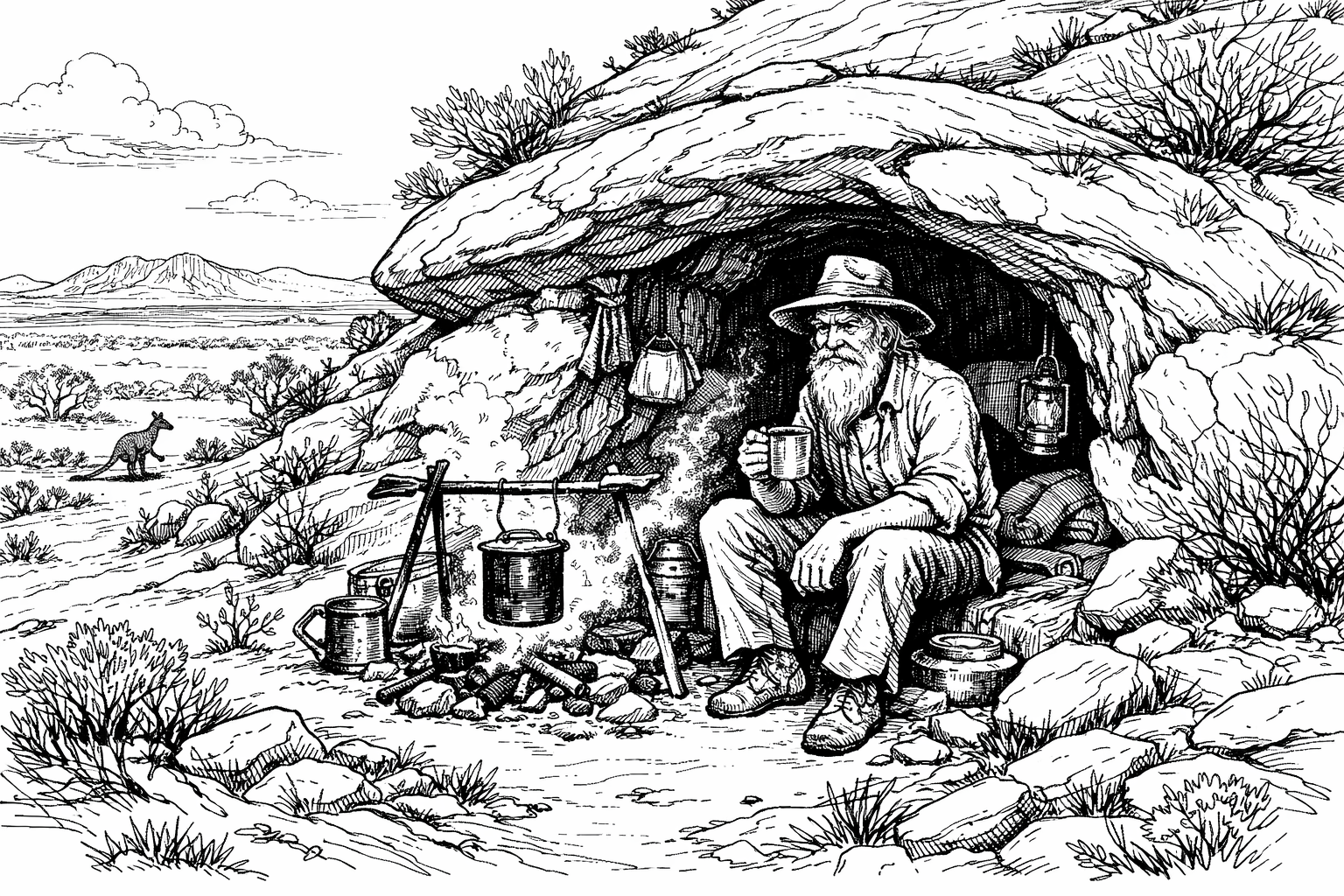
A cave, on a hill overlooking a lonely road on the goldfields, has been converted into a hermitage by an old prospector, Joe Vesta, who has lived there alone for many years, seeing only the mailman once a week and an occasional traveller. Vesta came to Western Australia in 1894, arriving at Coolgardie just in time to join the rush to a new mine that was afterwards called Kintore, after Lord Kintore, who floated a company to work on a group of leases there. This was only the first of many rushes in which he took part. He prospected on most of the fields in the state and has known both hardship and riches. One of his finds, the Sydney Mint, he sold for £30,000. But the money was spent as it often is, and later he found himself crippled with rheumatism; he could no longer work and had no resources but a qualification for the old-age pension.
BACK TO KINTORE
Something drew him back to Kintore, where he had first known the bustle and high hopes of a new mining camp. Kintore had had a short life. Vesta returned there, where all that remained of it was several dumps, a heap of bottles marking the site of the hotel, and a cave formerly used as a magazine for explosives, on the side of a hill commanding a view of a stretch of the road from Coolgardie to Gnarlbine. He established himself in the cave and has lived there ever since. If their caves were as good as his, he considers the medieval hermits did not do themselves too badly. His novel residence is warm and dry in winter and cool in summer. Anyone passing along the road can’t miss seeing it. The mailman travelling to Carbine brings him his stores once a week, and any traveller rarely passes by without stopping for a yarn and to leave a newspaper or a magazine. or some little luxury.
FENDS FOR HIMSELF
As there was no settlement within many miles of his hermitage, these were the only persons he saw for several years; but recently, two prospectors have been working near Kintore, so now he has neighbours. Though he is so badly affected with rheumatism that he has difficulty in getting around with a stick, he scorns any suggestion of hospital or Old Men’s Home, and to date, he has managed to fend for himself and even, on his best days, to pan a prospect or two. Most of his time, he sits at his door and thinks. A well-educated man, he has a little shelf of books in his cave, and as travellers are fairly frequent nowadays, he is never more than two or three days behind in the affairs of the world as told in the newspapers.
With abundant leisure to study and consider the news, he is always ready for a topical discussion on anything from metaphysics to metallurgy. His visitors are. often surprised at the profound and original apophthegms he utters. Seen from the door of his hermitage, the poor remains of Kintore — a place which once hummed with activities from which hundreds of investors at the other side of the world hoped to make fortunes — are only a patch in a great sea of green scrub that stretches away to a purple horizon. With this view, constantly before him, it is little wonder that, though he has occasional flashes of humour, most of old Joe Vesta’s views are tinged with a tranquil but melancholy sense of the vanity of human wishes.



Moya Sharp
Latest posts by Moya Sharp (see all)
- Dear Reader - 10/10/2026
- Doyle’s Well: Coaches, Cold Beer and Frog Cocktails - 10/10/2026
- A Fate Worse than Death – Lost in the Bush - 10/10/2026
Not such a bad retirement plan….