
The Herald Melbourne VIC – 13 January 1934, page 24
My Life Outback as a Mule Driver’s Offsider
On The Track With One-Spur Dick
by Arthur W Upfield
To One-Spur Dick, I owe a debt never to be repaid. Here on Tearle Station, Western New South Wales, set down in the middle of the night by a mail driver and blurred into obscurity by lack of sleep. It had been One-Spur Dick’s drawling in-junction to
“Get up before the sun burns the whiskers off you,”
which woke me to this new world. Fully dressed, I arose from the soft sand beside the track where I had collapsed into unconsciousness on alighting from the buckboard, to observe four men regarding me with amused eyes, “Another parcel post bloke,” one observed, as though I were a beetle, “Yaas. English or Orstralion?” “What are you, young feller?” inquired | a one-eyed, thick-set, whiskery, sun-blackened man, dressed in blue shirt and moleskin pants, and wearing but one draggled spur. “English,” was my reply, as I gazed around me at the stone-built bungalow house and the skirting corrugated-iron buildings.
I slept part of the time while I ate breakfast and retained a dim memory of being escorted by the whiskery man to the men’s hut in which I slept the rest of that day and night. The following morning, with the others, I presented myself to the manager for orders and was told to assist the tinsmith. He was making two 4000-gallon iron water tanks, and my work was to hold a hammer head against which he riveted the curved iron sheets. It was mid-February, and the sun was trying. For two weeks I lived in close contact with Blue Evans, a 14 stone Welshman; Mick Conolly, a tall, flashily dressed stockman; Sam, a full-blood Aboriginal; Sam No. 2, a half-caste who shot galahs on the wing with a 22 bore rifle; the Wandering Burglar, and the wife of one Charlie Monger, and the mother of eight children, only two of whom were not half-castes and of course One-Spur Dick then the bullock driver.
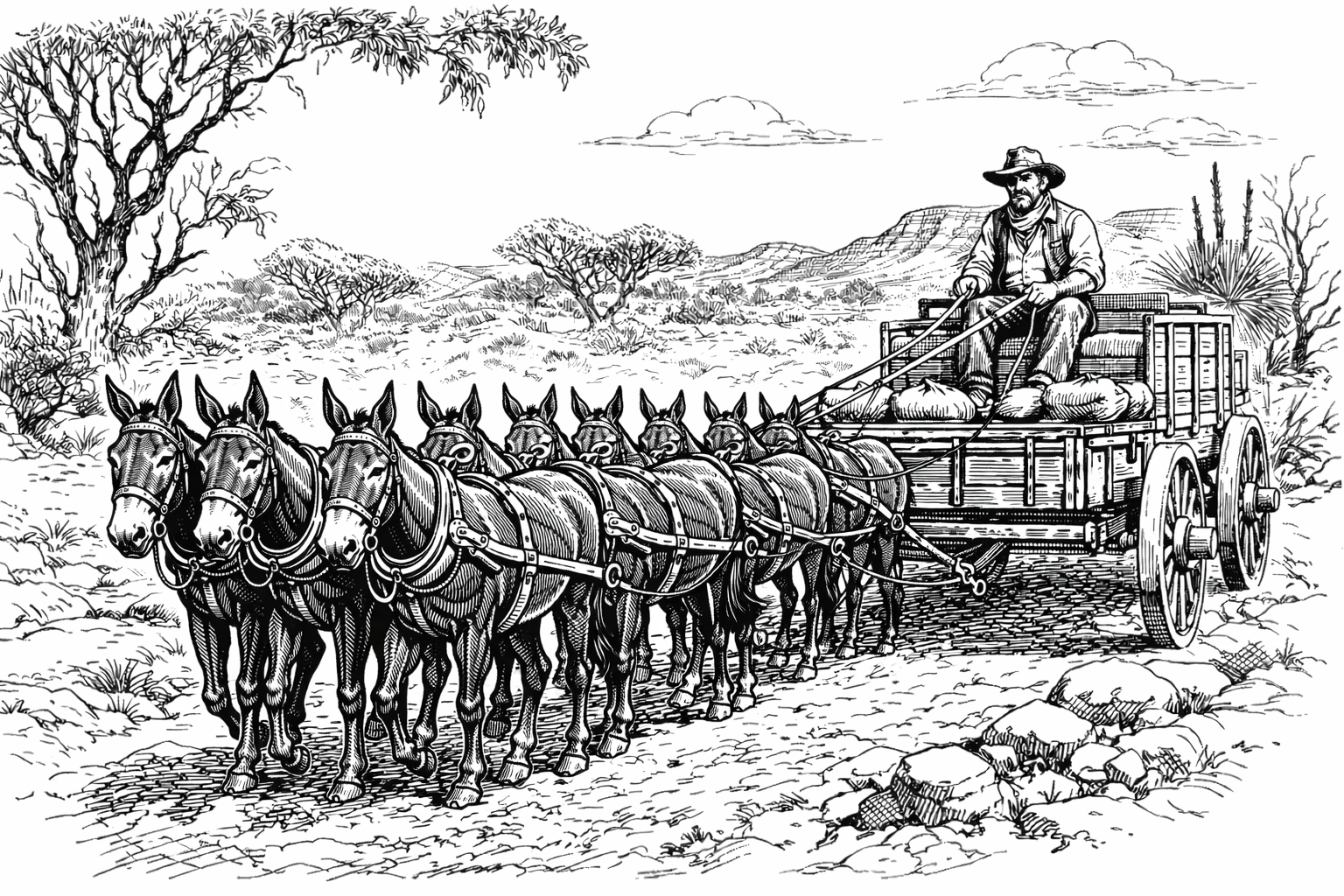
Never before had I met such people; never have I met their like away from the Interior since. Their language was terrific, saved from crudeness by its artistry. Their leg-pulling was severe; tempers were quick, and fists were hard. Their hearts were big, their humour dry, and the standard of general knowledge surprisingly high. The tanks having been made, I was sent as offsider to One-Spur Dick to go fetch in the winter wood supply, with fourteen bullocks drawing an ordinary wagon. During the morning of the first day, when we were among dense mulga, it occurred to me — how would I get back to the homestead if my companion dropped dead? The one-eyed driver — he had lost an eye in a fight at Mount Brown— sternly repressed a leering grin and commanded me to use my brain. For half an hour, I endeavoured to do this, my cursed imagination producing vivid pictures of a lost man dying of thirst. Eventually, I admitted failure to use my brain, Dick said, with grave deliberateness, “I like a bloke who arsts questions. I got no time for a bloke, be he new chum English or new chum Australian, wot thinks he knows everything and arsts no questions to hide his ignorance.
Now you see them wheel tracks? You go and stand in one of ’em with your back towards the wagon.” When I had done as he ordered, he said: “Now shut your eyes. Got ’em shut?” Receiving my affirmative answer, he said: “Now you keep your eyes shut and walk in that track for twenty minutes, and you’ll knock out your mosquito brain against the store wall.” Here is an illustration typifying the character of this great man. When assured that in me he had a willing pupil, nothing was too much trouble to explain; and nothing was ever explained unless accompanied by a lesson which could not be forgotten!
He taught me how to bake a damper, how to kill and dress a sheep, how to make horse hobbles, how to ride in the Australian fashion and how to use my fists. He demonstrated that neither bullocks nor mules nor horses understood pure English or pure Chinese but would pull like the devil when addressed with a proper mixture of all the oaths of both nations, topped up, as it were, by the worst oaths favoured by the Afghans.
Talking To Mules
“Here, have a go at ’em,” he urged on our first 120-mile trip to Broken Hill with wool. He stopped the team. I took the eight-foot whip, he climbed up to the top of the mountain of wool and pretended to go to sleep. I called to the team of sixteen mules. The leaders looked around with bored curiosity. Twice, I almost managed to choke myself to death with the whip. When I managed to lash the shafters, they pulled the wagon forward, but the front part of the team, one and all, yawned. Three times I fell flat, tripped by the whip. I played on a simple variation of two bad words, but they were seasoned, hackneyed British oaths, and of no earthly use. The team was enjoying a quiet siesta while I became very hot and then, over them, rushing outward through the quiet bush, roared a flood of language of such artistry as to be unequalled in any other part of the world. The effect was electrical. Sixteen animals, a huge tabletop wagon, and ten tons of wool abruptly sped towards Broken Hill.
As the wagon passed, I managed to grab an eye at its rear, and despite entanglements with the whip, kept with it without using the single near-side rein — Dick scorned such aid, excepting when negotiating the steep hills of the Barrier Range — my chief pulled up the astounded mules as easily as he had started them — with his voice. Eventually, having learned the language, I got on much better. My memories of Dick are still vivid. I see him trudging beside the team, an old felt hat set back on his head, the one clanking spur, the long-handled whip over his shoulder with the thong trailing along the ground, making a snake track. The whip he rarely used, it was seldom necessary.
Swags unrolled on the ground, my head towards the fire, which he carefully fed to keep a good light, I read aloud for hours to him of Sexton Blake, and the work of Stanley Weyman and Charles Darwin. Unable to read, his memory was prodigious, his appetite for any quality of food contained between covers insatiable, equalled only by that for beer, when that kind of food was available.
A Lone Job
Three trips we made to Broken Hill that winter, going south with a mountain of wool, returning north with a mountain of cased rations and fencing wire. The two leaders and the two shafters were allegedly broken in. The rest of the mules we broke in on the track. Twice I saw a pair of hoofs presented one foot beyond my face, once the sleeve of my dungaree jacket was torn away. Towards the end of the trip, the team was settling down, but by the end of the third trip, a change of employment was dictated. It so happened that camping a night on the Wilcannia Common, we failed, when coming back, to find two of the mules the next morning, and were compelled to go on without them. I was sent to the Common Ranger to report the matter, and, having done this, I found the team drawn up outside the Globe Hotel, and poor Dick very drunk within.
“Best thing to do is for us to plant him on top of the load, and for you to drive out to town and camp,” said the Publican.
“You can’t pull the team out ere.” I thought that the best thing he could have done was not to permit Dick to become drunk. I was no mule driver; I was a new chum. There were four mules which, even then, required our united efforts to unharness and harness. So, they shifted the load a little and made a hole in the top of the mountain into which Dick was dumped, and picking up the whip, I whistled to the team, uttered some of the ‘Esperanto of the bush’, and away we went. Now we were bound for the Tearle out-station, to reach which it was necessary to cross the dry Parroo River, a few miles out of town. There were two ways of crossing it, over the bridge, or by taking the track twisting down one bank and up the other. Twice before we had come this way, and because Dick feared that the team would be frightened by the bridge rumble, he had chosen the twisting river-bed track.
Mug’s Luck
Discovering that I was getting along famously and knowing that this part of the common was as bare of feed as a city street, I determined to push on until Dick regained consciousness. And now there was the white painted long bridge, making me debate which crossing I would take, and before I had made any decision, the leaders reached the bridge. Now they were on it, their hoofs sounding hollowly on the loose flooring. One of the body mules snorted. Now the shafters, now the wagon itself was on the bridge. I clung to the brake handle, praying that if they bolted, they would draw the wagon over the bridge on my side. Then, when halfway across, Dick roared, and the team instantly stopped. I looked up, and I saw his face peering over the edge of the supplies mountain. His frozen eyes were gazing down, down beyond me, down to the riverbed 50 feet below the bridge.
The team was halted. Several of the mules were snorting like donkeys. The leaders looked likely enough to turn and rush back. Dick’s voice was a faint whisper. “Go on— gat ’em off the bridge,” he implored, incapable of any other thought, and mentally and physically frozen with horror— in a place where angels would fear to tread. Six feet on either side of the wagon was a 50-foot drop! We would have been across the bridge had he not come to. I was now as windy as poor Dick, who was enduring a nightmare. But with unmeasured luck, although three of the team began to plunge, the leaders pulled straight, as did the shafters. Once we were clear of the bridge, Dick stopped the team and very nearly fell off the load. In Chinese, he described my ancestors back for five hundred years, danced with rage, and rushed away to return to the hotel.
Thereabouts was no place to camp, even if I did successfully manage to unharness the team, and even if I had done this, it would have been impossible to harness them in the morning, new chum as I was. There was nothing else for it but to accept the gamble and push on to the out-station singlehanded, despite two bad creeks to cross.
Yet babies, drunken men, and new chums seldom come to harm.
Taking the team onto the out-station, I thought, was something heroic. But the fellows could not see it. All they could visualise was Dick looking over the edge of the ration mountain down to the dry bed of the river. But to One Spur Dick I owed a thorough breaking in, the acquisition of a new and up-to-date foreign language and the catching of opal gouging fever for which I gained £370 of opal, but that’s for another story!
Excerpt from MY LIFE OUTBACK – available from ETT Imprint at $24.95 – email Tom Thompson at ettimprint@hotmail.com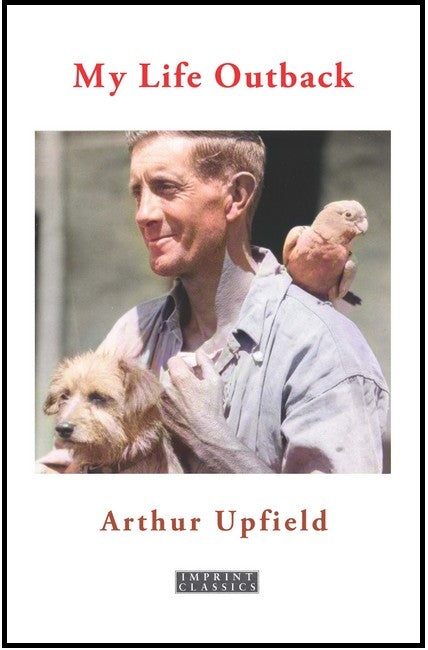


Moya Sharp
Latest posts by Moya Sharp (see all)
- Dear Reader - 10/10/2026
- Doyle’s Well: Coaches, Cold Beer and Frog Cocktails - 10/10/2026
- A Fate Worse than Death – Lost in the Bush - 10/10/2026
Leave a Reply