
George MOUNTJOY – 36 yrs, buried in the Cue cemetery in Dec 1895, location not specified. He was born in Cheltenham, England. He was reported missing by a friend who last saw him leaving his camp near Cue in the Murchison of Western Australia to go to his workplace a short distance away; he was not carrying any water.
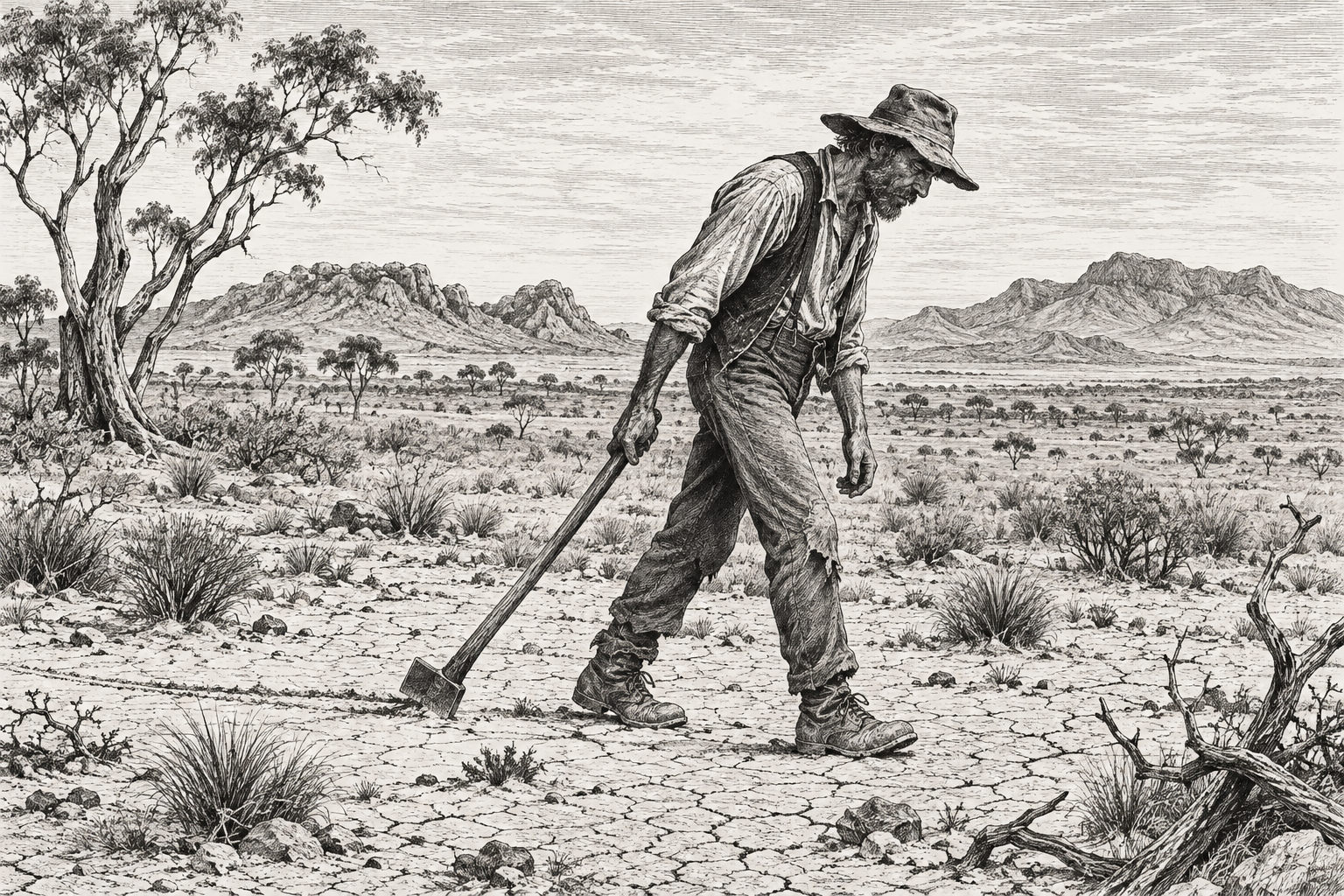
The police conducted a five-day search and eventually found his clothed body with his woodcutting axe, which he had dragged the whole time, some 10 miles southeast of Cue after having covered about 120 miles in random directions. The cause of his death was later decided at an inquest in Cue to have been excessive heat and the want of water. He had previously been lost, also requiring police rescue, at Yalgoo, Western Australia a few months ago. His occupation was that of a woodcutter, but he had previously been an engine driver in North Dakota, USA.
Inquirer and Commercial News – Perth – 3 January 1896, page 13
LOST THE BUSH.
FIVE DAYS WITHOUT WATER.
A TERRIBLE DEATH.
The Murchison Times of December 18 has the following news — In our last edition, we made a brief allusion to a man named George Mountjoy reported to be lost a few miles out of Cue, off the Nannine road. Constable Hehir, in the company of a police tracker, was out in search of the missing man from 3 o’clock on the 10th until 11.30 last Sunday morning. The work proved to be anything but of a light nature, the man having wandered in almost every direction, and over very rough country. On the first day, he dragged after him the axe with which he had been cutting timber, which, of course, greatly assisted the search party. On one occasion he was tracked within two miles north-north-east of Cue, near the Table Top, and then he again struck out east. At one place he went within 20 yards of a gnamma hole in which there was abundant water. He must have travelled, altogether, about 120 miles, and walked about in the blazing sun for fully five days without a single drop of water.
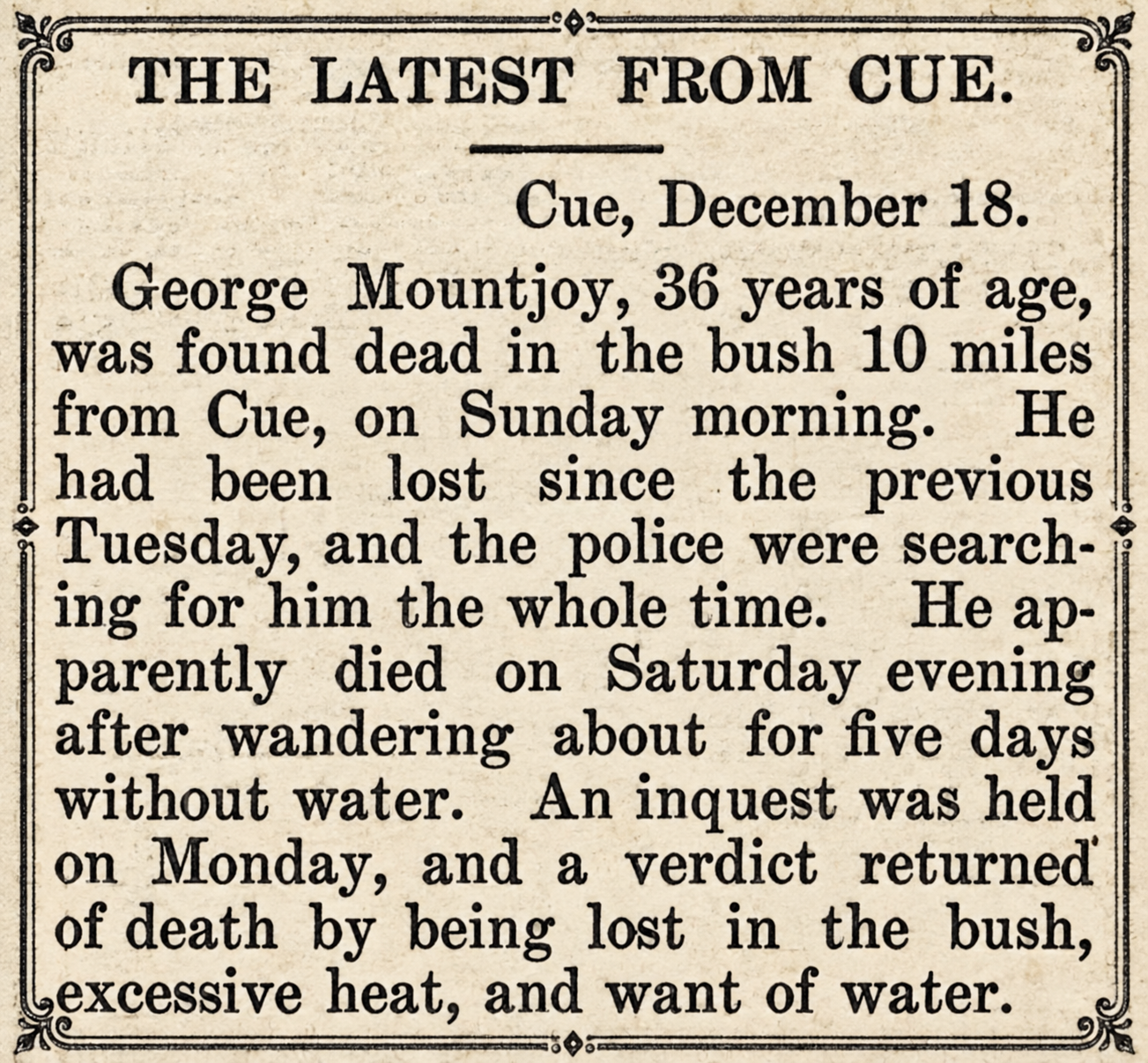
Geraldton Murchison Telegraph 20 December 1895, page 3
The extent of his sufferings was only too plainly evident when his dead body was found, on Sunday morning, about ten miles southeast of Cue. His face was quite black, and he appeared to have died in terrible agony on the previous evening. He possessed a remarkably strong constitution; otherwise, he could not have endured the immense fatigue that he did walking almost until he dropped dead.
He did not, as is usually the case, become delirious and strip off his clothes but, according to appearances, he maintained his consciousness to the last. The search party went two days without water and had it not been successful in finding a soak, it would have been compelled to return without completing its work. The deceased, who was 38 years of age, was a native of Cheltenham. England and, according to a certificate found in his possession, he had, for some time prior to his arrival in the goldfields, followed the occupation of an engine driver in North Dakota, USA.
It is only a few months past since he was lost in the bush near Yalgoo for about five days, and on that occasion, he was rescued by the police.
An inquest on the body was held on Monday at the Cue Courthouse, before Dr Ramsay, J.P., and a jury consisting of Frederick A. Braddock (foreman), Thomas Williams, and James F. Marks. Arthur Pirnell stated that he had been acquainted with the deceased for some 10 months. The last time he saw him alive was about 7.30 a.m. on the 10th inst. The deceased was then leaving camp to go to his work, about one mile and a half away. He did not return, and the witness, therefore, after trying to find his tracks, sent in for police assistance. The police arrived on the morning of the 11th inst.
The deceased was in his usual health and spirits when he left the camp and carried no water. He could identify the body as that of the deceased. Constable Hehir stated that he set out on the morning of the 11th inst. to search for the deceased. He picked up the tracks on the afternoon of the same day and followed them until Sunday morning, the 15th inst to a spot about 10 miles south-east of Cue, where he found the body, clothed, with an axe lying at the side of it. There was no evidence of any struggle. The jury returned a verdict to the effect that the deceased met his death by being lost in the bush, and that he died from the excessive heat and from want of water.



Moya Sharp
Latest posts by Moya Sharp (see all)
- The Angels on the Hill – Some Memoirs of a Nursing Sister - 19/09/2026
- Rafferty’s Rules and Rough Justice at Niagara - 19/09/2026
- Twenty Yards from Water – the man who was lost twice - 19/09/2026
Leave a Reply