
The Sun Kalgoorlie 8 March 1903, page 10
Bill the Topman of Stringer’s Brewery
By Pharisee.
Bill Stiggins had been at Stringer’s brewery from the start, in fact, had helped to put the building up. “Saur the first load er muck took outer the cellar and sampled the first beer, “he said when the origin of the factory came up for discussion in the cooper’s shop. Before Bill came to the fields, he was lumping on the Fremantle wharf, but tiring of the occupation, he joined a crowd of new arrivals who were making for Hannans, and duly arrived at Southern Cross, where he struck up an acquaintance with Stringer. Stringer was a man chock full of ideas, and unfolded many schemes, more or less impracticable, as he and Bill footed it along the dry, dusty track which led to Coolgardie. “Best thing I can think of to make money is a brewery,’ remarked Stringer. “Look how they tear it into them,” pointing towards a party that sat by the roadside opening ‘English’ by the dozen. Same everywhere you go.
‘Brewery! Yes, that’s the thing, and by Jesus I’ll start one.”
But d’yur know auything about the game?” inquired Bill. “Oh, yes,” replied Stringer, me old man useter run a 5-hogshead plant in Victoria, and I learnt a wrinkle or two. I’ve got 200 quid and can borrow a few more if pushed.” Bill became hopeful for the success of the project on finding that funds were available, and took a deeper interest in it when Stringer offered him a job as Topman. “That,” said Bill, after relighting his pipe, that was how the brewery was first started, and how I comes ter holding this ‘ere important post.’ It took a long time to build that brewery, and God knows where Stringer got the money from, but, eventually, a structure with no claims to architectural beauty reared its head upon a patch of sand not far from Hannans. Some said that Stringer used to loot the teams at night for building materials, but he punched several insinuating persons who tried to circulate the libel, and nipped the slander in the bud. The brewery was on the tower system, and water was pumped to the top boiling vat by an antiquated engine that threatened to burst at any moment. Its unsafe character, together with the recklessness of the engineer in charge, who always had it at high pressure whether it was wanted or not, caused several residents in the immediate vicinity to move further away.
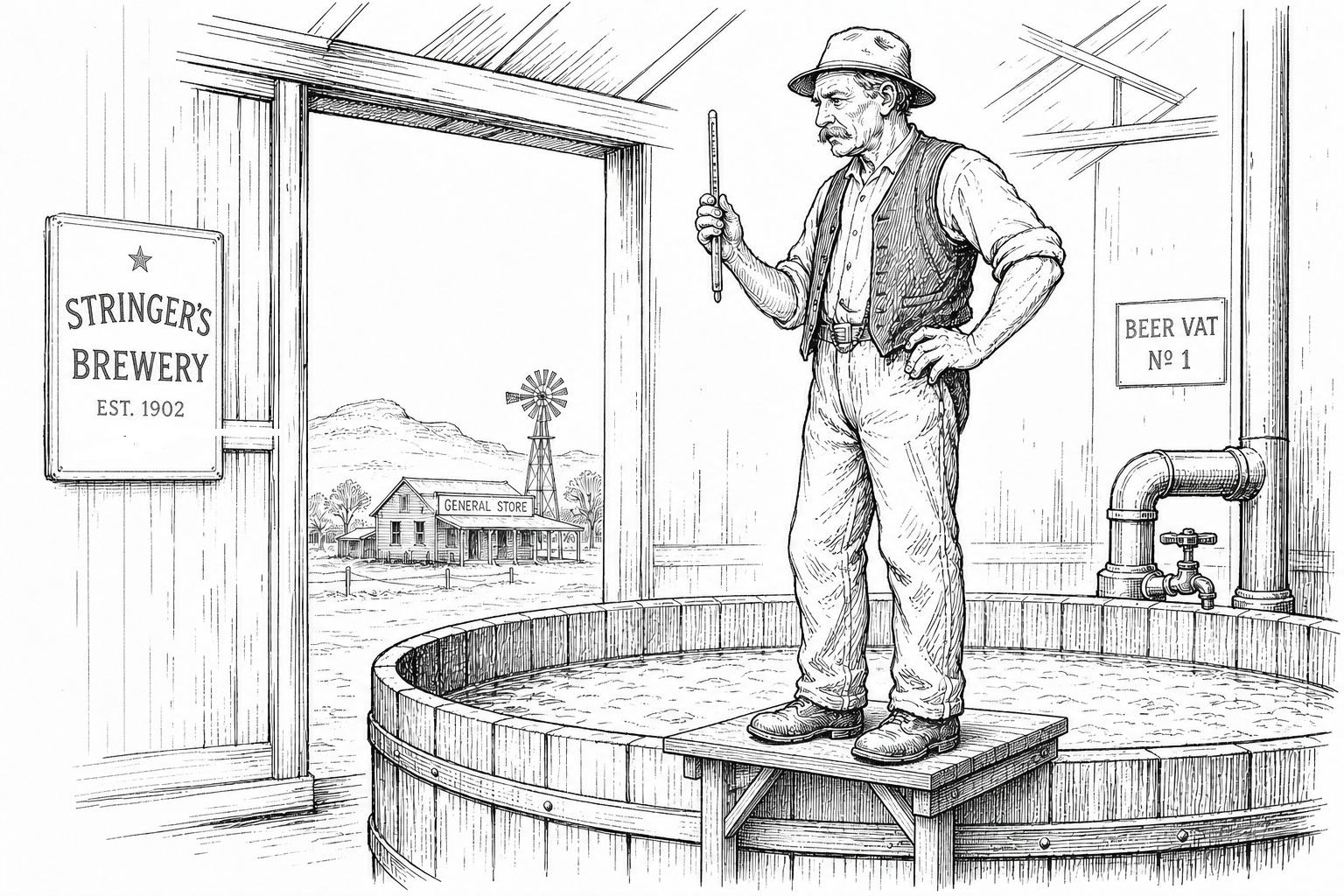
Several old vats, the cracks stuffed copiously with bags, were rigged up, and a cooler made out of flattened kerosene tins was artistically arranged close by. A few egg-casks, in the absence of better barrels, were to do duty as cleansers, and the first brew, after much desperate struggling and swearing, was put through. It failed. ‘You see, it was like this,’ explained Bill, Stringer. Instead of looking after his work, we went about town drinkin’ with friends who were congratulatin’ him, an’ we all got pretty well boozed as well. The result was that the engine driver pumped water from the saltwater tanks, and we never knew of the mistake until the beer came down in the cellar. Talk about hog-wash, it was no name for it. I got some down without thinkin’, and nearly heaved me boots up. Stringer comes along and tastes it. ‘ Hell,’ he says, and hits me on the nose. I never heard such horrible oaths. You’ve rooned me, yer blanky spungers,’ he says, an’ a lot more.”‘
After a while, he cools down, an’ we carted the stuff inter the bush, where some natives gets into it, an they was mad fer nearly a month.’ Stringer carefully supervised operations when the next brew took place, and a pretty good liquor was the result. Things went smoothly for a long time after that, and trade was growing fast when a sad calamity befell Bill. He was hanging over the fermenting guile, taking the temperature of the frothy mass within, when, somehow or other, he overbalanced and fell in. Of course, he was dead in a minute or two. As he was in the habit of absenting himself at intervals from the brewery, not much notice was taken, so Stringer, though he swore a bit, undertook the Topman’s duties and brought the liquid into the cellar himself. He marvelled over Bill’s continued absence. “Can’t make it out. Suppose the ‘blanker’ is camping it off somewhere,’ he said, as he went on topping up the new beer in the cleansers.
It was Bill’s duty to clean down after brewing, so no one else ventured near the vats. The big demand for beer caused Stringer to rush the liquid through the cleansing process, and in two days, it was ready for distribution amongst the various pubs. In the meantime, an exhaustive search was being made for Bill, who could not be found high or low. “Them vats must be cleaned out anyhow,’ said Stringer to Cook, the cask washer,’ and you’d better take the job on.’ This meant promotion to Cook. He abandoned the cask washing department immediately and set to work. The top vessels were finally unloaded of residue — such as grains and hops — and the cooler was swept clean. Cook climbed onto the fermenting guile now coated with hard yeast, and commenced to scrape it off. Enclosed in a dark corner of the brewery, the light was faint, and things at the bottom of the vat were not easily seen. The brewer pottering about in the cellar was startled by a howl of dismay proceeding from the floor above, and several other wild shrieks accompanied by the sound of someone jumping heavily on the floor brought him in haste up the ladder.
Cook, with hair on end, was rushing towards him, yelling ‘ Bill, what’s up? ” demanded Stringer. ‘Bill,’ again shrieked Cook, with horror written all over him. ‘He’s in there.’ Stringer turned pale and jumped on the edge of the vat, from whence he peered through the gloom into the bottom. There he saw the bloated outline of a man clothed in dungarees, shirt, and boots, lying very still. ‘
By Gawd, it’s Bill all right,’
he exclaimed and was about to jump in when a sudden thought rushed through his mind. He called the horrified cask washer to him. ‘Don’t say a word about this or I’m rooned. If the public gets an inkling of the truth, we’ll never sell another barrel.’ Cook swore fervently to keep mum. ‘ I ain’t one er them sort ter go blabbing.’ It happened to be Saturday, so all hands were away during the afternoon, according to custom. The brewer and his henchman had a clear run, and soon dragged the earthly remains of Bill from the guile’s bottom, and placed it in a long box. ‘We’ll take him over to his camp, put the box and all on the stretcher, and cover him up,’ said Stringer. ‘Then we’ll give out that he died suddenly, and I’ll get old Dr Snoozer — him that’s always bumming round here for booze — to give a certificate of death.’ Everything turned out exceptionally well. Stringer manufactured a coffin, and Bill was put in it, without much ceremony. The employees all came up to the camp to cast a last, farewell, and mournful look at it. ‘Poor ole Bill,’ said Cook, who was in a maudlin state, ‘he wasn’t a bad bloke, fer all his growlin.” ‘He had his good points,’ murmured the engine driver sympathetically. The bottlewasher and his mate, who were both pretty drunk, indulged in audible groans. They was never so broke up in their lives before. Tears rolled down Stringer’s nose as he joined in the general sadness. Old Snoozer, also full up, spoke learnedly of the case. ‘It was a case of paralysis of the heart, after a heavy bout — a perfectly natural death. Have seen many similar cases, especially in India, where ‘ That’ll do doctor,’ observed Stringer, ‘we won’t say no more about it,’ and the mourners retired to the cellar, where all hands, bar Stringer, Cook and the doctor (they drank whisky) absorbed beer till nightfall.

Stringer went uptown. ‘Splendid beer yer makin’ now,’ said Murphy, of the Mulga Arms. ‘Great improvement in it. If you only keep it like that o’ill av no one else. There’s a taste about it that makes it equal to English.’ Murphy pulled a glass. It was a beautiful colour, and a lasting head surmounted the top ‘ Yes,’ said Murphy, emptying the glass with a gulp, ‘ best beer o’ive tashted on the fields.’ Stringer shuddered slightly and returned home.
Next morning, Bill Topman’s remains were stowed away in a hearse, but the funeral was somewhat delayed owing to a dispute between the ex cask washer and the engine-driver regarding the sort of monument to be erected over Bill’s grave. ‘ I say no,’ said Cook in loud dogmatic tones, ‘ ordinary sandstone ain’t good enough. I vote we send to Scotland and get some real first-class granite. Bill’s worth it. The engine driver was of a different opinion and called Cook a liar. The ensuing contest was both gory and long, but Stringer eventually separated the combatants, and the funeral started, the brewery lorry ending the procession with a few inebriated employees. It was a sad and dreary cortege that struggled along through a drizzling rain to the cemetery. Some of them pulled up at the last pub to have a drink and arrived when the burial ceremony was over.
An unfortunate incident marred the lowering of the coffin. Cook stood too near the brink of the grave, and blind with emotion, fell down on Bill’s remains. He was extricated with difficulty and scandalised the parson by swearing horribly at the bottle washer’s mate, whom he charged with shoving him in. In speaking of the matter afterwards, the Rev. Tooler turned up his eyes with holy disgust, and said it was the worst experience he ever had. He left before the grave was filled, and the rest struggled homewards soon afterwards, after making a collection for the grave-digger, who said ‘ they were a rum lot er blokes.’ This veracious narrative is written with a view to clearing up the mystery surrounding Bill the Topman’s death, and also to show what kind of a beer establishment Stringer’s brewery was in the early days, and furthermore to illustrate the deep grief felt by the employees over Bill’s untimely demise.
Stringer still flourishes, and Cook is his right-hand man. The doctor expired soon after the incidents related, so the secret of the guile is only shared between the two. Though some years have elapsed, there is yet no monument over the topman’s grave, and the bottle-washer — now advanced to the dignity of cellar-man — often ‘ chyacks ‘ Cook about the granite he was going to fetch from Scotland.



Moya Sharp
Latest posts by Moya Sharp (see all)
- Dear Reader - 10/10/2026
- Doyle’s Well: Coaches, Cold Beer and Frog Cocktails - 10/10/2026
- A Fate Worse than Death – Lost in the Bush - 10/10/2026
Leave a Reply