The Man Behind Kalgoorlie’s Grandest Buildings
Geoffrey Oswald Hawkins
Geoffrey Oswald Hawkins (1870-1936) was born on 10 July 1870 at Sandhurst (the town regained the name Bendigo from 1891), Victoria. He was the third of twelve children born to Edward Jackson and Eliza Rebekah (nee Annear) Hawkins, who had married at Sandhurst in December 1866. Geoffrey was the brother of Ernest, Norman, Hester, Ethel, Stewart, Herbert, John, Grace, Basil, Violet, and Ruth. Geoff Hawkins’ father was a civil engineer around the Bendigo area, at Strathfieldsaye Shire from 1876 to 1882, when he moved to the Loddon Water Trust, hence to Inglewood (45 km north-west of Sandhurst) where he consulted to several trusts and shires. One of Geoff Hawkins’ relatives was Harold Desbrowe Annear (1865-1933), also born at Sandhurst, and later to become a renowned architect in Victoria.
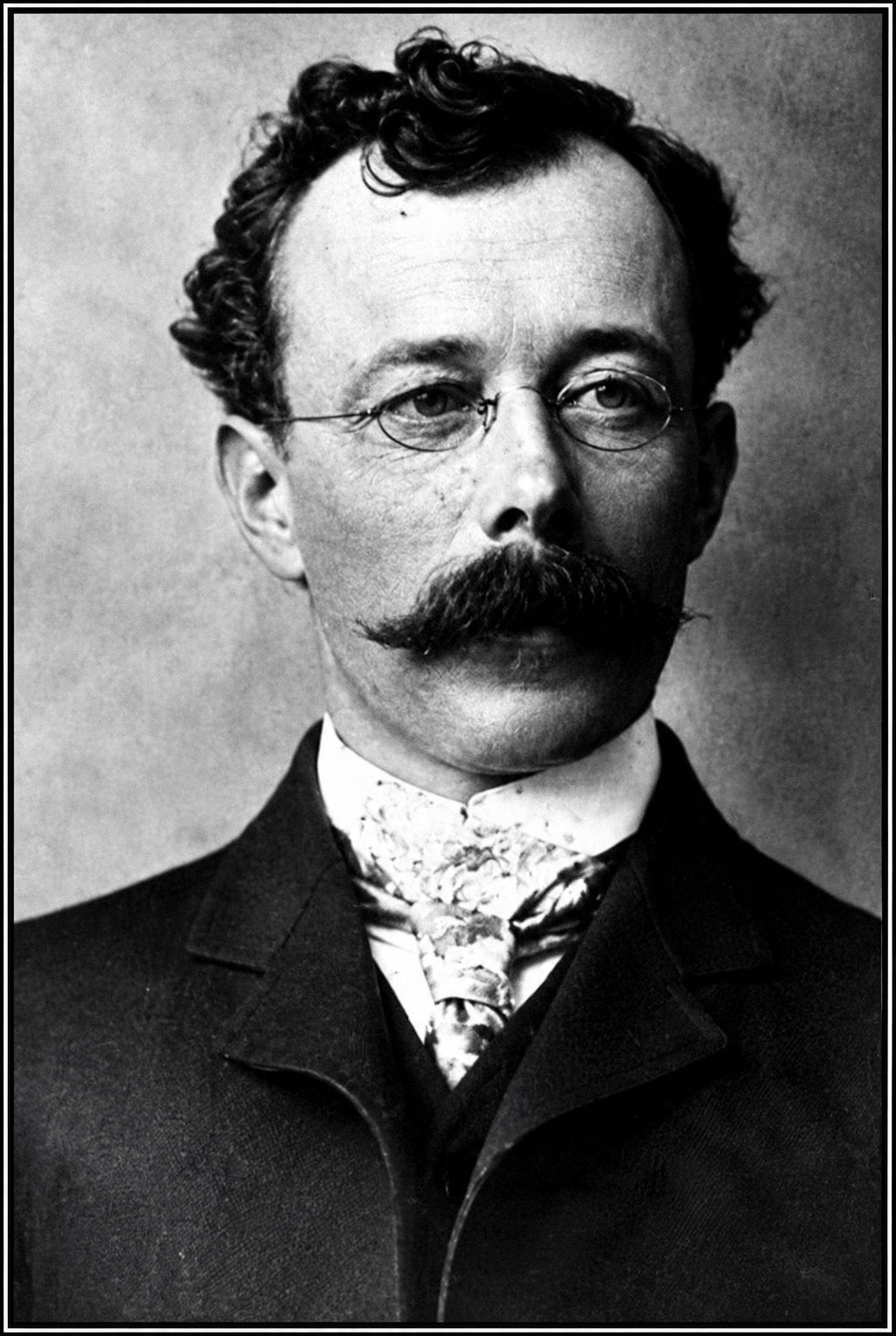
Geoffrey Oswald Hawkins – The Truth, 10 March 1906
In a somewhat complicated family relationship, Harold’s father James Desbrowe Annear married for the second time in 1863 to Edward Hawkins’ sister Elizabeth; and then Edward Hawkins married Eliza, the eldest daughter of James Desbrowe Annear in 1866, both marriages being held at All Saints Church, Sandhurst. Edward Hawkins passed away at Inglewood in October 1890, aged just fifty years, and it seems Geoff may also have been living there at this time, as he was appointed a ‘life governor’ of the Inglewood Hospital by 1895. Details of Geoff Hawkins early education have not come to light, but it is likely that he attended school at Inglewood, and may have obtained further architectural training in the Sandhurst/Bendigo area. With a severe recession on the east coast of Australia in the early 1890s, Geoff followed an exodus of Victorians to the gold-mining boom of the ‘Western El Dorado’ at the Coolgardie-Kalgoorlie goldfields in Western Australia, where he arrived in April 1895. By October 1895 Hawkins was calling tenders for a hotel at Bulong (east of Kalgoorlie), and in this case he was acting as the Kalgoorlie agent for architects Moline and Summerhayes of Coolgardie. Hawkins must have impressed his employers, as by late November 1895 the Kalgoorlie Miner newspaper carried notice of the partnership of architects Moline Summerhayes and Hawkins having an office at Maritana Street, Kalgoorlie. Geoffrey Moline (1865-1943) and Edwin Summerhayes (1868-1944) were also
‘refugee’ architects from the eastern seaboard of Australia.
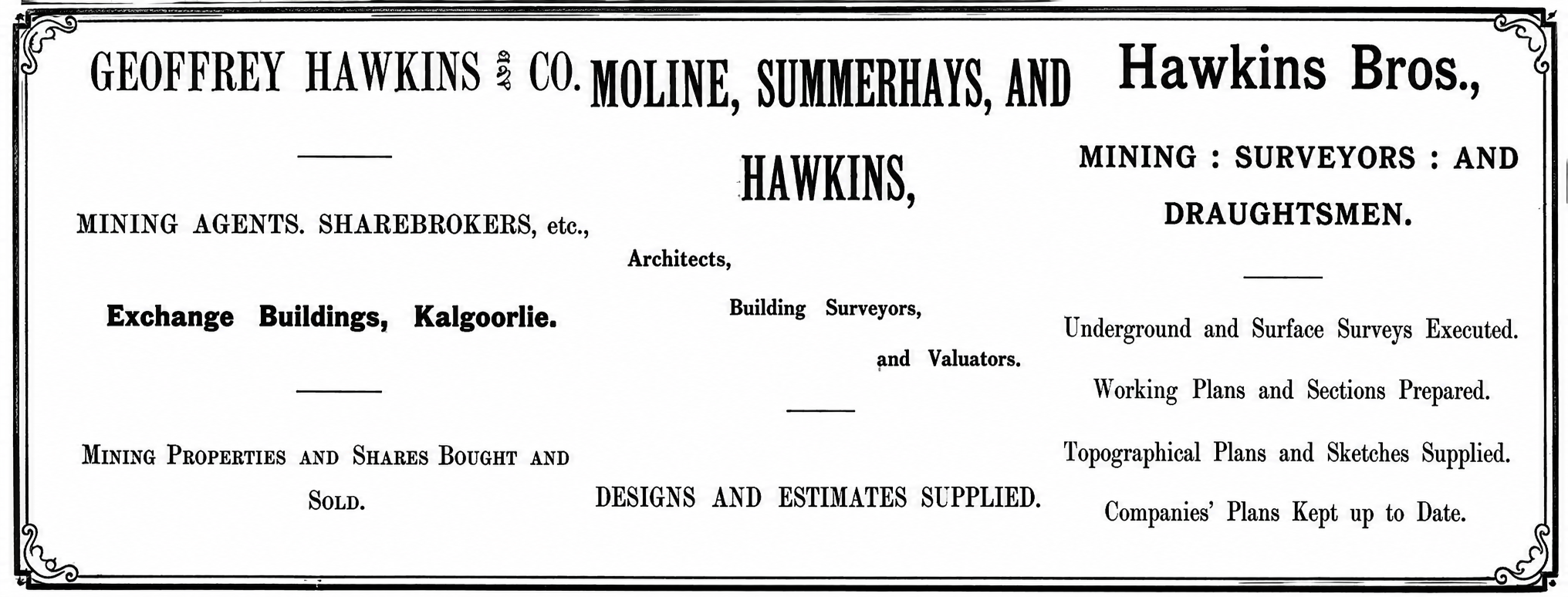
Geoffrey Hawkins’ various business interests – Kalgoorlie Western Argus, 12 March 1896
With dire sanitary conditions on the goldfields, by March 1896 two sisters of the St John of God nursing order were brought to Kalgoorlie, and by July the designs of a new St John of God Hospital were produced by Moline Summerhayes and Hawkins, with the estimated cost of the building at £3,000. At 88-90 Hannan Street, Kalgoorlie, the Grand Hotel of 1896 was also designed by Moline Summerhayes and Hawkins.
The Grand Hotel Kalgoorlie 1904 – Image TROVE
In the exceptional and expansionary conditions of the late 1890s, Geoff Hawkins became one of Kalgoorlie’s most prominent architects. Another talented individual, Daniel Thomas Edmunds (1864-1925) moved from Mildura, Victoria to Kalgoorlie around 1896, and some of his earliest work in the WA Goldfields was in 1897, acting as Clerk of Works for Moline, Summerhayes and Hawkins on Parer’s Restaurant in Hannan Street, Kalgoorlie. Later in 1897, Dan Edmunds was working with Hawkins as Hawkins & Edmunds Architects, on John Heale’s Imperial Wine and Beer Saloon, also in Hannan Street. It seems that in the cut-throat business conditions of the frontier town, architectural partnerships were hastily formed to ensure procurement of ongoing projects. It is also evident that partnerships were established specifically to undertake large-scale commissions that required greater resources. In September 1897, the Kalgoorlie Miner carried notice of dissolution of the partnership between Hawkins and Edmunds. Hawkins had ensured that he had alternative business opportunities should architectural work prove scarce, and Wises Directory of 1897 advertised Geoff and his next eldest brother Norman H. Hawkins at Boulder Chambers in Maritana Street, Kalgoorlie trading as ‘Hawkins Bros, Mining Surveyors and draughtsmen’.
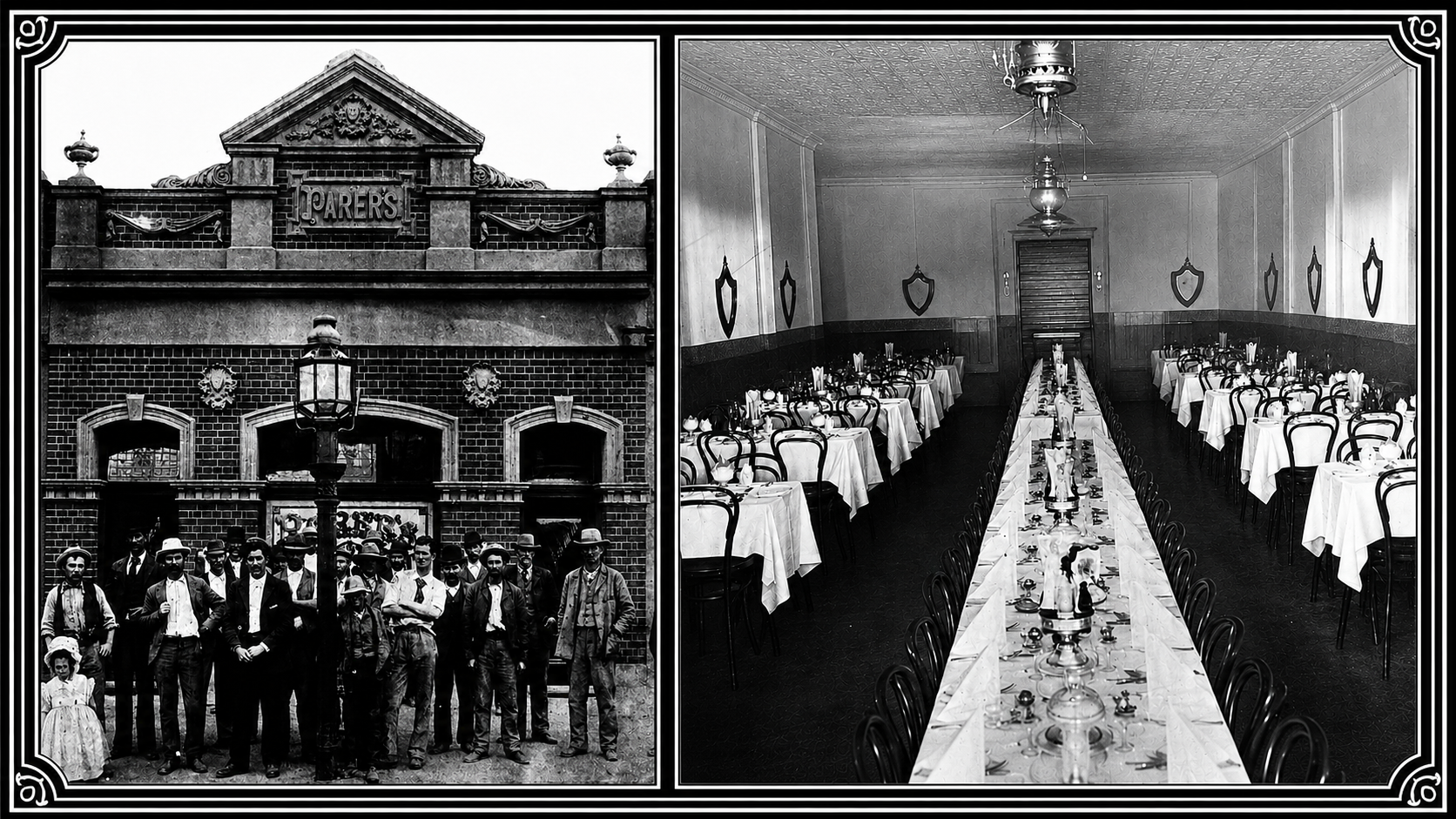
J.C. Parer’s Restaurant, Hannan Street, Kalgoorlie (Kalgoorlie Western Argus, 13 May 1897
Geoff Hawkins was active in local affairs, and was a member of the Kalgoorlie Roads Board by 1898. For the extensive Brennan Bros’ (drapers and clothiers) shops and warehouse at 124 Hannan Street in 1898, Geoffrey Hawkins, architect, employed Hedley Vicars Sprigg (1864-1939) as his supervisor for the works. Sprigg must have impressed Hawkins, as from 1 February 1899 they entered into a business partnership, and the two men worked together, employing others under their direction in the practice until 1907.
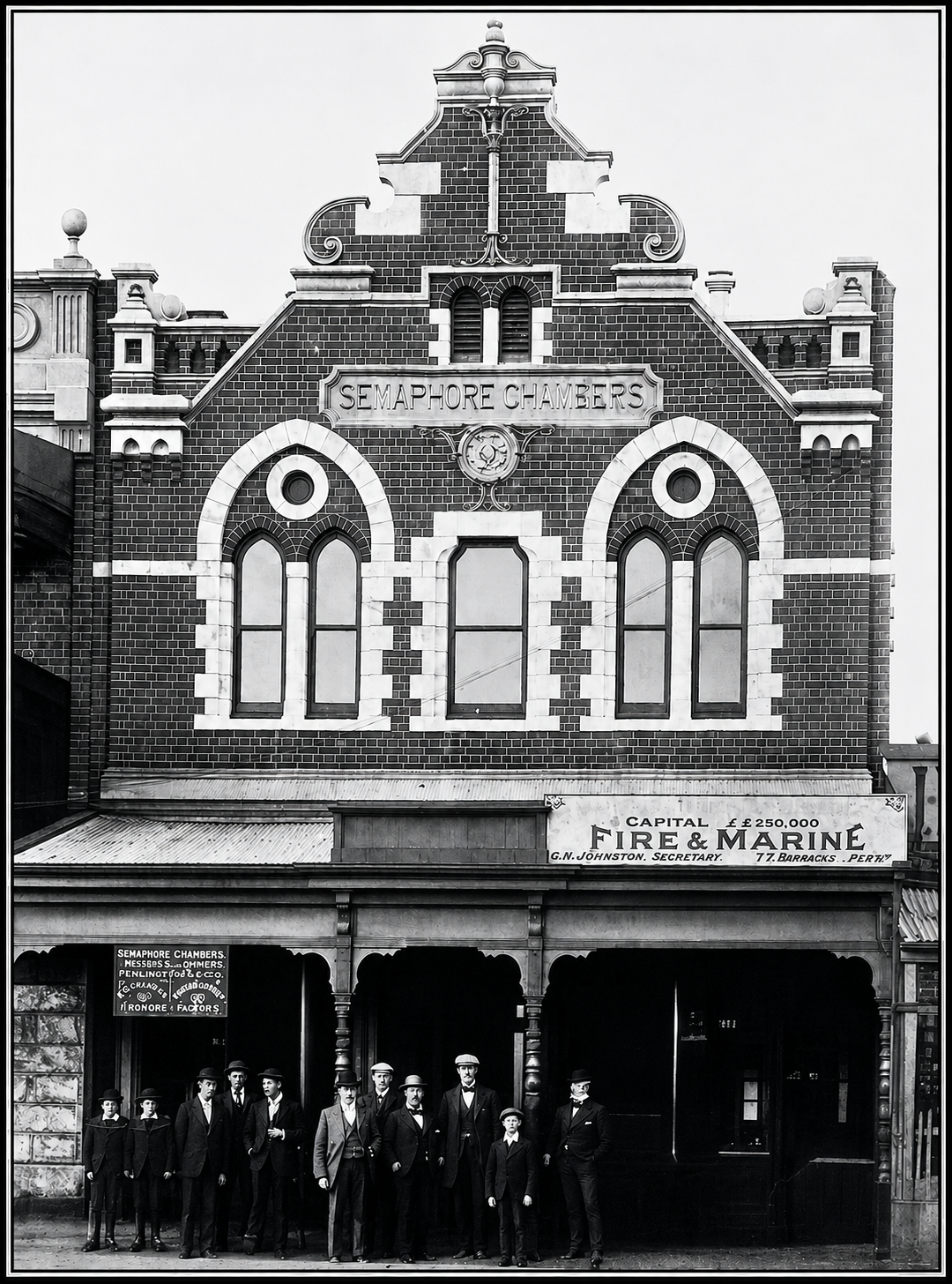
Semaphore Chambers, 77 Hannan Street, Kalgoorlie, designed by Hawkins and Sprigg in 1899 – Image TROVE
Built in 1899 to replace a predecessor destroyed by fire, Semaphore Chambers is representative of the third phase of construction at Kalgoorlie between about 1898 and 1908, when the original flimsy ‘shanties’, followed by timber and iron buildings, were in turn replaced with substantial masonry-walled structures. Strengthening the family presence in the burgeoning town, Geoff’s eldest brother Ernest Edward Hawkins (1868-1937) was appointed Town Clerk at Kalgoorlie in April 1900 at a salary of £400 p.a. There were 157 applicants for the position. It was noted of Ernest that his brothers, Messrs N.H. and G.O. Hawkins, are among the best known of Kalgoorlie residents.
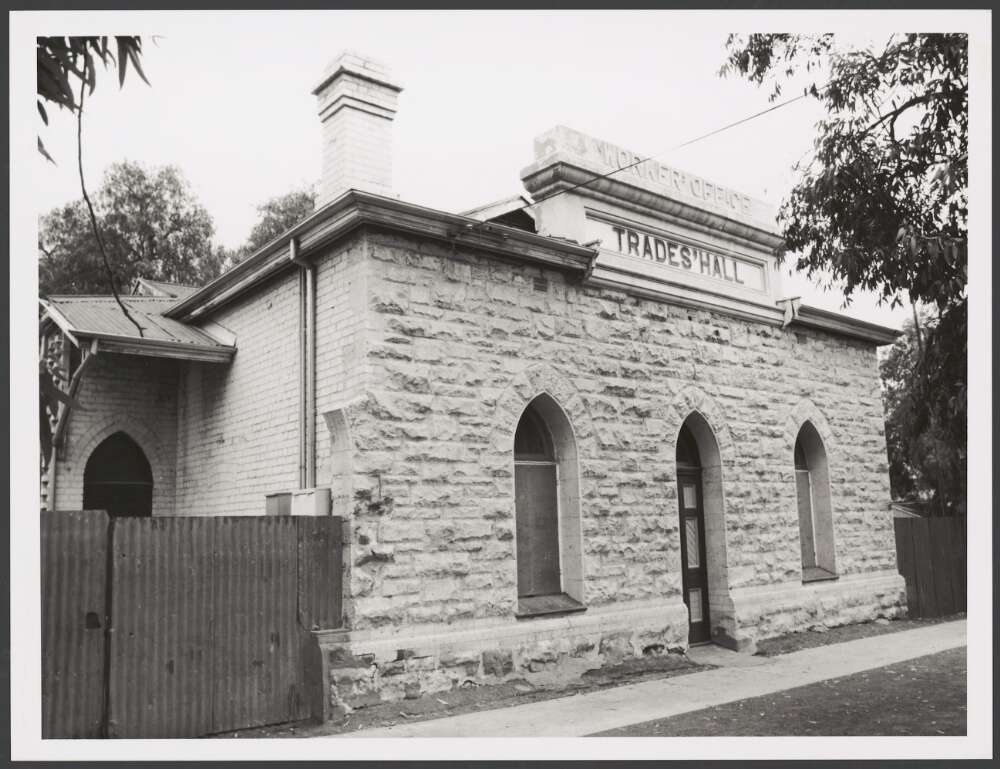
Trades Hall of 1900 at 30 Porter Street Kalgoorlie – Image SLWA
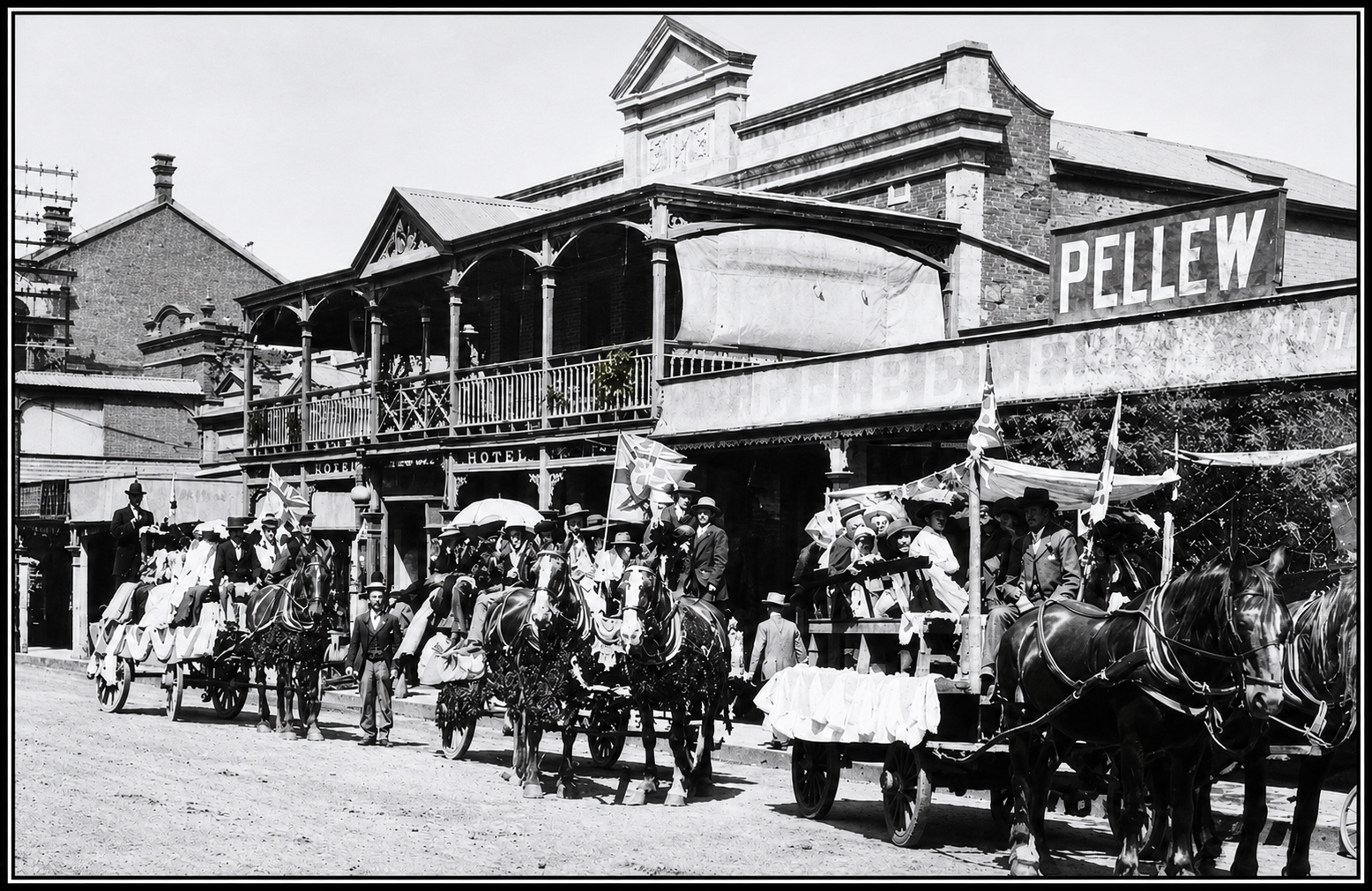
The Kalgoorlie Trades Hall, originally designed by Hawkins and Sprigg to be a two-storey building should the activity of the organisation increase sufficiently, was officially opened on 7 December 1900. They were also the architects of the fabulous Exchange Hotel at 135 Hannan Street, Kalgoorlie, completed in early 1901.
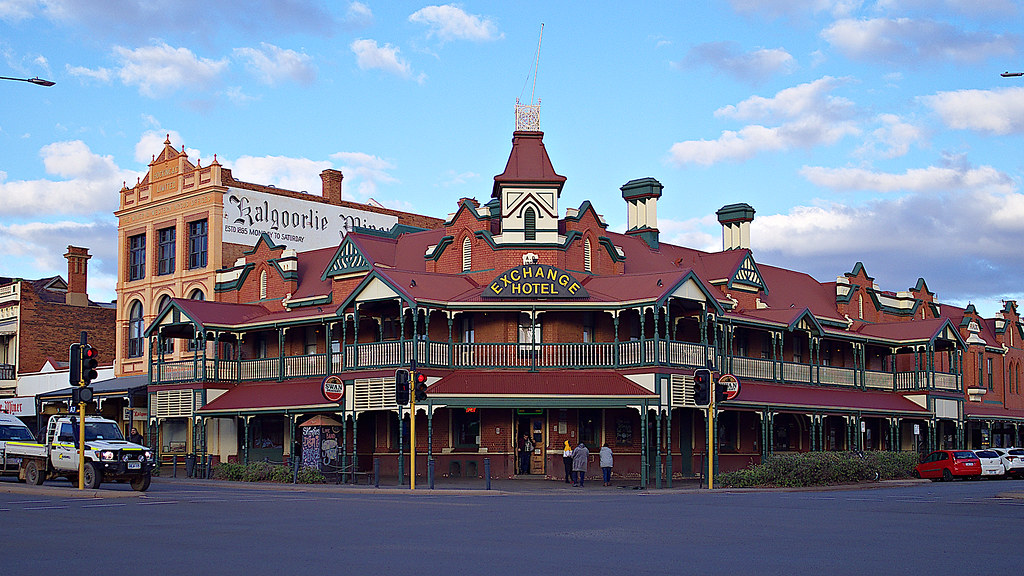
Exchange Hotel, 135 Hannan Street, Kalgoorlie, completed in early 1901 – Image Google
Hawkins and Sprigg produced the Australian Natives’ Association Hall on Hannan Street (near Wilson Street), finished in late 1901, and in this extremely busy period, they were also the architects for the Kalgoorlie Roads Board building at 39 Porter Street, Kalgoorlie, opened in December 1901.
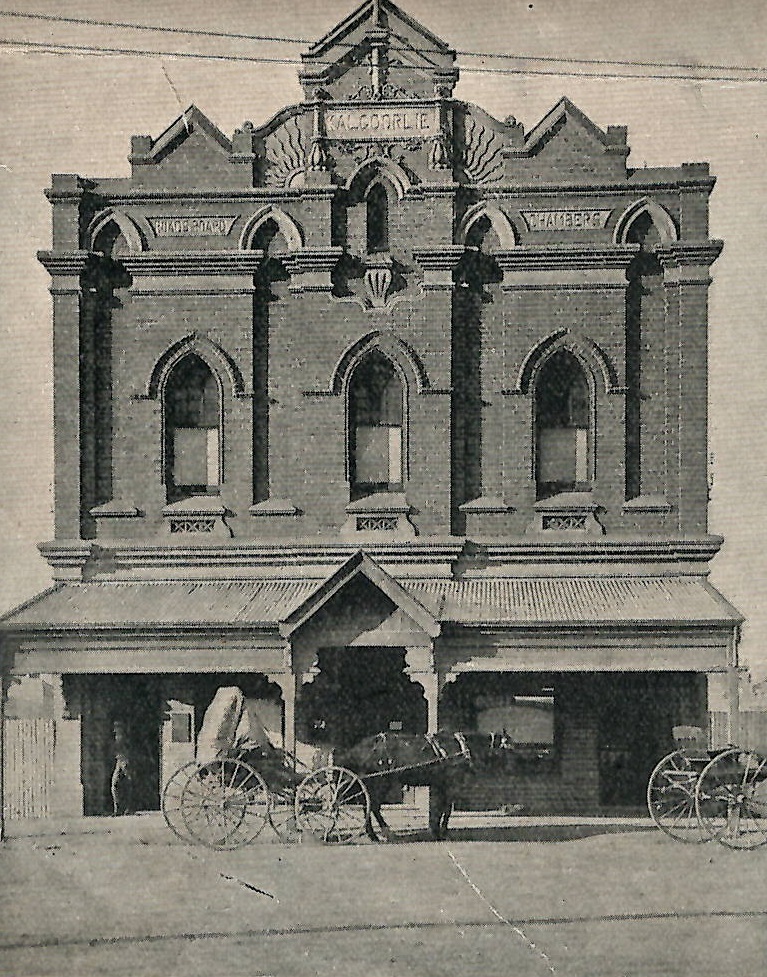
Kalgoorlie Roads Board building of 1901 at 39 Porter Street, Kalgoorlie – Image TROVE
Despite all the work he was undertaking in the burgeoning Kalgoorlie area, Geoff found time to embark for Adelaide, where he and Beatrice Mary Edwards were married by the Bishop of Adelaide on 6 November 1901 at St Luke’s Church, assisted by the father of the bride, Rev. H.J. Edwards. The couple had at least four children – at his death Geoff was noted as the father of Esme, Sheila (b.1905) and Beatrice (b.1907). In August 1902 the Kalgoorlie Miner had reported the birth of twins (a son and a daughter) to the couple at Moarta in Collins Street, Kalgoorlie, but the West Australian newspaper of March 1912 carried the sad news of the death of their son Douglas Kendall Hawkins at Charles Street in South Perth, aged just nine and a half years.
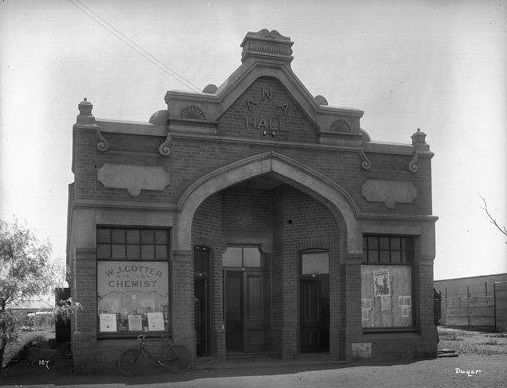
Australian Natives Association Hall – 360 Hannan Street, Kalgoorlie – Image SLWA
In 1902 plans were underway for the imposing St Mary’s Church at 24 Brookman Street in Kalgoorlie, to a design by prominent ecclesiastical architects Cavanagh & Cavanagh of Perth. The contract for the building was let under the supervision of joint architects Hawkins and Sprigg. The dynamic partnership was responsible for many works at the Kalgoorlie Race Course in the early 1900s, including the Museum (as the Jockey’s Room), and the Leger Stand. In 1902, the Maritana Buildings were constructed at Brookman Street in Kalgoorlie, designed by Hawkins and Sprigg. This firm was by this time well established in the Kalgoorlie area, designing other prominent buildings such as the Union Bank, and the Brennan Bros’ works from 1898, including a Hannan Street arcade of 1902.
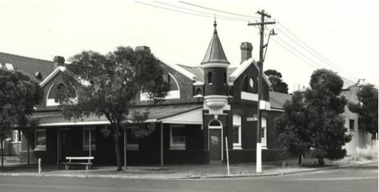
Maritana Buildings at 40 Brookman Street in Kalgoorlie were designed by Hawkins and Sprigg in 1902 – Image SLWA
Hawkins and Sprigg called tenders for the Friendly Societies Hall at 23 Porter Street, Kalgoorlie in late 1902, and the building was opened in January 1903. In February 1903 it was reported that a contract had been let for the construction of new premises for the Kalgoorlie Club at 108 Egan Street, designed by Hawkins and Sprigg in bungalow style. Other works by the firm in 1903 included four shops in Maritana Street, Kalgoorlie, and offices for the Great Boulder Perseverance Gold Mine. McKenzie’s Buildings is an interesting two-storey plus basement, brick and iron commercial premises constructed in 1904, designed by Hawkins and Sprigg in flamboyant Federation Free style.
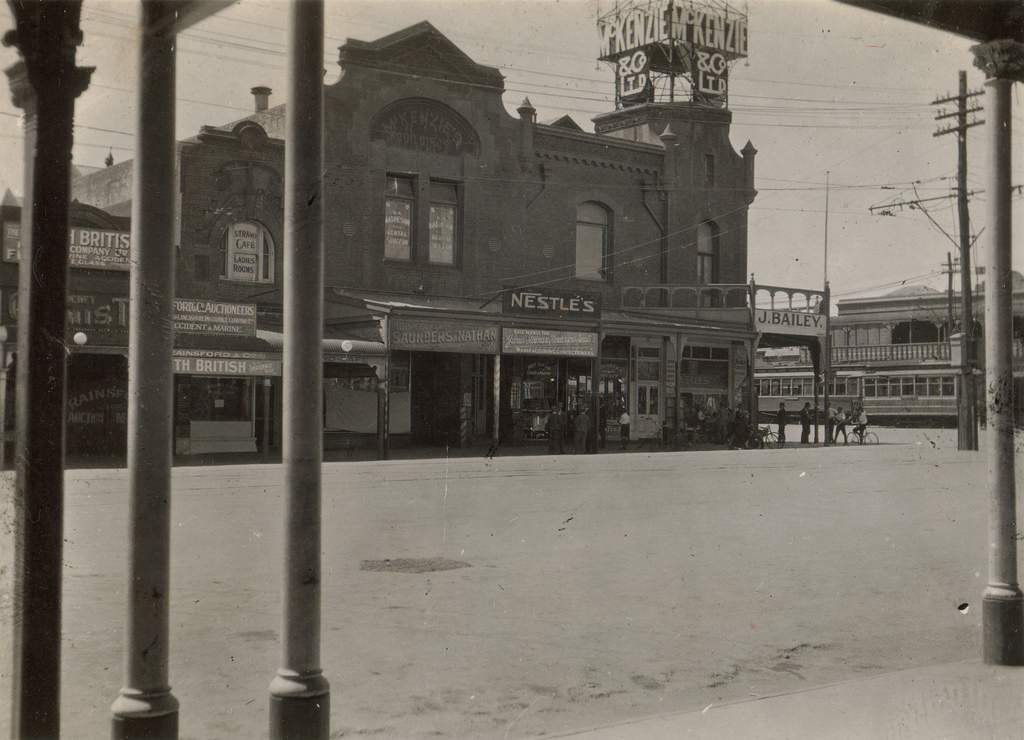
Hannan Street frontage of McKenzie’s Buildings at Kalgoorlie, designed by Hawkins and Sprigg in 1904 – Image SLWA
Ballarat-born architect Jack Learmonth Ochiltree (1870-1954) was listed in Perth during 1903-1904, working in a partnership with Hawkins and Sprigg, probably his former employers at the goldfields, as Hawkins Sprigg & Ochiltree. Continuing to seek expansionary business activity, in early 1905 Hawkins and Sprigg purchased the Boulder-based practice of another Ballarat-born architect, Murdoch McKay Hopkins (1865-1904), who had passed away from tuberculosis at the very young age of just 39 years. In late 1904 Hawkins and Sprigg called tenders for two-storey premises in Hannan Street for H.E. Laslett, but at this time the late-nineteenth and early-twentieth century surge of commercial activity at Kalgoorlie-Boulder was beginning to slow. With the decline in work, in July of 1905 the Kalgoorlie Western Argus reported that Geoff’s brothers Norman and Basil Hawkins were emigrating to Canada, where they would be able to find a wider scope for their energies than is presented by the eastern goldfields. With a young family, Geoff was perhaps less inclined to recognise the gradual weakening in business that was unfolding, and he was lauded by the Truth newspaper in March 1906 as:
A Popular Goldfields Pioneer – Hawkins: Architect. Mr G. O. Hawkins, of the architectural firm of Hawkins and Sprigg, Kalgoorlie, possesses the proud distinction of being the pioneer architect of the eastern goldfields.
Mr Hawkins made his debut at Kalgoorlie 11 years ago, when the embryonic inland city was still very much in the mulga, and consisted largely of 6 x 8 tents, condensed water, Barcoo rot, tinned dog, and “gold top” at 40s a bottle. Mr Hawkins designed nearly the whole of the principal buildings that now decorate the dusty landscape of ‘Shockingville’, and was first chairman of the local roads board. In addition to being a fine all-round sport and various other things too numerous to particularise today, Mr Hawkins takes a deep and abiding interest in the welfare and destiny of the people. With the waning of architectural opportunity, Hawkins’ partnership with Hedley Sprigg had been dissolved by early 1907. By July 1908 Hawkins was bankrupt. He is not listed as an architect in 1909-1910, but is listed on his own at 105 Egan Street, Kalgoorlie during 1911-1912, when he may have been undertaking drafting work for mining companies. His bankruptcy was given a pay-out figure in 1910, and discharged by 1912, when the family had moved to South Perth.
During 1913-14 Geoff Hawkins is listed in practice at 33 Barrack Street, Perth, but a lack of tender notices would indicate that he was not undertaking works of significance. By 1914 the family residence was at Suburban Road (Mill Point Road), South Perth. With a lack of business, Hawkins may have been motivated by both patriotism and commercial need when he enlisted for First World War (1914-1918) service at Perth in March 1915. On the enlistment form, he gave his occupation as surveyor, and next of kin as his wife at Suburban Road. Hawkins embarked at Fremantle as an Acting Sergeant on HMAT A64 Demosthenes on 23 July 1915, arriving at Egypt in August. Geoff Hawkins travelled to the Western Front from Alexandria and Marseilles in June 1916, and was wounded in France during September 1916. He joined the engineers in 1917, by which time his wife and three young daughters were living at 10 Norman Avenue, South Yarra in Melbourne. He survived the remainder of the war, and in 1919 was appointed as a Survey Officer for the Commonwealth War Graves Commission, sent to Gallipoli to assist in the task of memorialising Australia’s souls lost in the dreadful battles of 1915. Discharged from the War Memorial section of the Australian Imperial Forces at London in late 1919, Geoff returned to Australia in the summer of 1920, and appears to have stayed in his home State of Victoria from the age of 50 years.
Hawkins died suddenly at 65 years of age in April 1936 at 28 Sutherland Road, Armadale, and was noted as the father of Esme, Sheila (Bowden), and Beatrice (Palfreyman). Other architects who lived and practised during the highly-charged boom period of the late 1890s and very early 1900s in the eastern goldfields of WA included Edwin Summerhayes, Edward Danker, Daniel Edmunds, Geoffrey Moline, Murdoch Hopkins, Ernest Porter, Edmund Thomas, George Lavater, Harvey Draper, and Tom Roberts. Geoffrey Hawkins is buried in the Box Hill Cemetery, Victoria, in an unmarked grave.
Sourced by Vonda Last, written by Dr John J. Taylor.



Moya Sharp
Latest posts by Moya Sharp (see all)
- Dear Reader - 10/10/2026
- Doyle’s Well: Coaches, Cold Beer and Frog Cocktails - 10/10/2026
- A Fate Worse than Death – Lost in the Bush - 10/10/2026
What a great read! It was an exceptionally interesting article about one of Kalgoorlie’s early pioneers.
Very interesting Moya. Hawkins Street is one of the Streets I have lived in with my Hubby and family. It is great to know these stories of the people our streets are named after. Thank you.
Another absolutely fascinating story. Thanks Moya. Was surprised about the Exchange.