
Sunday Times – 18 September 1932
THE ANGELS ON THE HILL
Some Memoirs of a Nursing Sister
by the First Hospital Trained Nurse in Coolgardie (Unnamed)
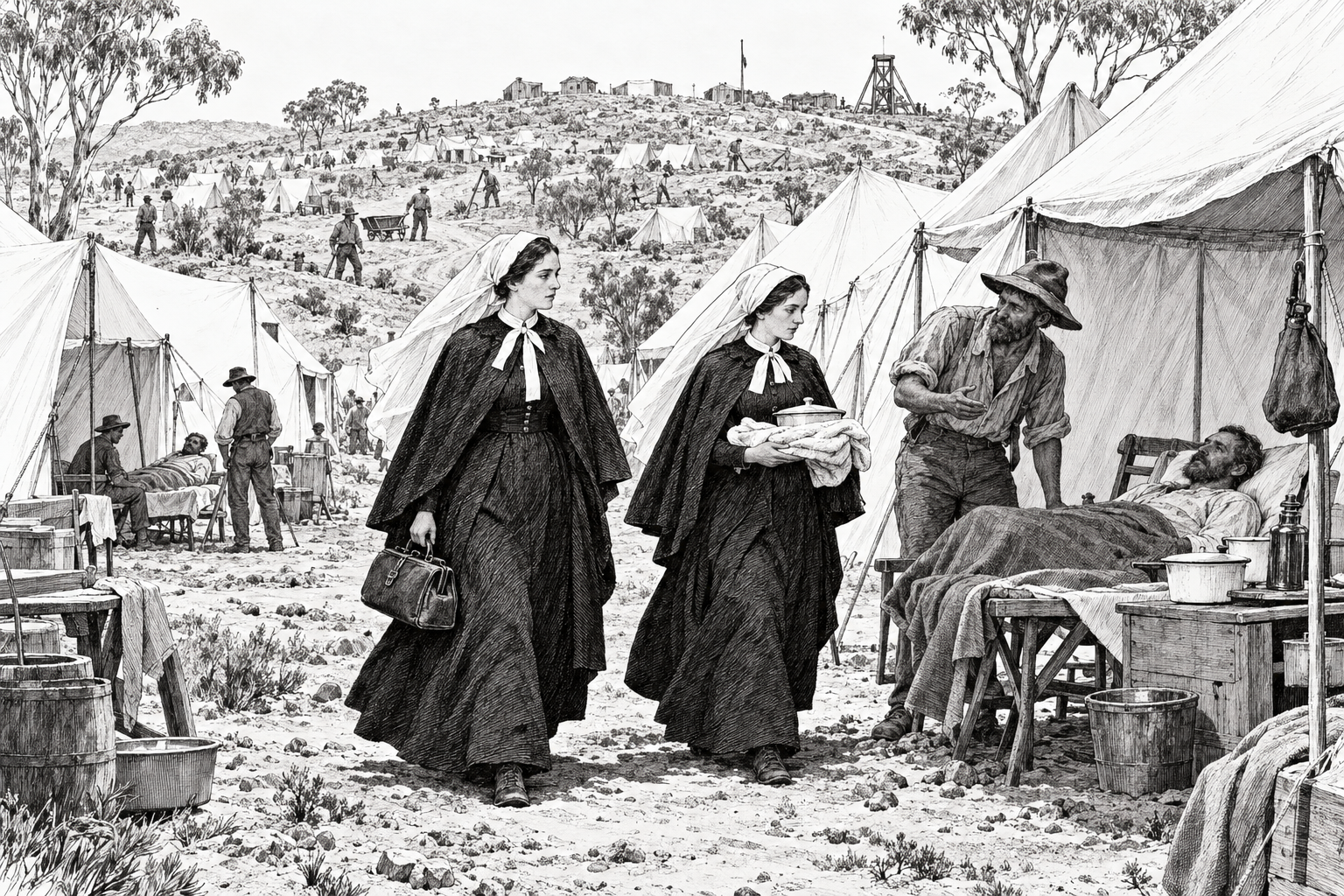
When I arrived in Coolgardie 38 years ago, it was midnight. In the morning, what a sight! White small canvas tents, tents and more tents. The same could be said of men — men everywhere. No roads — everyone ankle-deep in dust. Nobody wore a coat — I mean the men, of course, as there were no women to be seen anywhere. So the arrival of we two nursing sisters caused quite a stir. Wearing our uniforms on all occasions served as great protection to us, as we had many and difficult errands to perform.
So many requests from men “to be good enough to come and see his mate”
who was suffering from typhoid, which was then the scourge in this mining town. The nurse’s uniform of those days stood out. Navy cloak and bonnet with long flowing veil at the back, and large white tie strings — now discarded by the profession. A fellow traveller (Dr K.) on the coach offered to take us into De Baun’s Hotel dining-room for breakfast. He thought we might be a little nervous to enter alone. I kept my tryst, but my companion sister, suffering from a headache, did not make the attempt. When the door was opened for me to enter, I caught a glimpse of at least one hundred men at breakfast, coatless and hatless. Just grey flannels, some without shirts.
I fled — and a kindly barmaid brought us some tea and toast to our bedroom. This apartment is well worth describing. When we entered it, there were two women asleep on stretchers, and there was one left for us. Luckily it was of the pallias type, so one of us used the mattress on the floor, and the other the hard pallias. There were no blinds on the windows, so we used our nurses’ cloaks fastened up with hairpins. Neither water nor a washstand was available, so we had a “dry wash,” just rubbed ourselves vigorously with our towels. Nor were these things the worst.
When we woke up in the morning, there were sixteen occupants in this one room — arrivals during the night. There were women and children, including one boy of twelve years. However, we survived it all and set about finding a tradesman to erect our nursing tents. We called on Warden Finnerty, and he offered us the use of part of the Government reserve, and there we erected our four tents made of ship’s canvas, each tent holding a bed in each corner, and soon we were busy, more patients coming forward than we could ever accommodate. This, of course, was the only private hospital accommodation on the “fields.”
The Government patients, whom we had visited at the request of the Warden, were in a very bad way, in tents just dotted about under a few trees. Their sole attendant was an old man of sixty-five — very kindly, but with no knowledge whatever of the care of sick people. One youth I well remember because of his cheerful smile and red hair, had been in bed a week and still had his boots on.
All utensils were without any covering from flies and dust. The nourishment for the sick, as far as I could discover, was Sago and Maize boiled in water and then mixed with tinned condensed milk. Warden Finnerty asked us if we would mind if he erected tents for the Government patients adjacent to ours. Would we just look in and see that they were cared for by the male attendant? We consented, but found it all very unsatisfactory.
We then took over the care of them as well as our own private ones.
We advertised for experienced male attendants. Everything went well until there was a new find — and a rush took place. In the morning we were without helpers. Every man went to the rush. This often happened when the warders were downtown in the evening. They heard the news and their only luggage seemed to be just a bluey and water-bag.
Many distressing cases came to us; travellers for many days in high fever, sometimes on camels, sometimes lying down in a spring cart if lucky enough to find one. I well remember one case with a sore on each joint of his backbone. Our first duty to these patients on arrival was to cut their hair and beard off; then an all-over scrub. Sponge would not describe it. Then the great luxury of clean pyjamas, which we always managed to have by us — left behind by former patients for various reasons. I cannot forget the first death that occurred. The undertaker, quite new at his work and very young, came to me and said,
“I’ve brought the coffin, Sister.” He expected me to do the rest, he was so frightened. I had to assist, else he would have gone away without completing his task.
We had many kindnesses shown us; one, the earliest, was an offer of hot water every evening after our day’s work from the late Mr Bob Nicolson (afterwards manager of the Ivanhoe mine) who ran a condenser outside De Baun’s Hotel. We had kindly notices in the Press from Mr Clare, Mr Vosper, and friend “Dryblower,” who styled us “The Angels on the Hill”. My first bill for water was £90. I can’t now remember the length of time — probably a month- this water lasted. The fee for a laundress was one pound a day.
My contemporaries in Holy Orders were the Rev. Collick, Father Duff and the Rev. Trestrail — all very kind to the sick folk. The first church service I attended was in a billiard-room in Bayley-street, with earthen floor. Being the only woman present, I was given a candle-box as a seat. I daresay there are many of the old pioneers still living who could testify to the hardships and hard living in those days, with potatoes 10d. per pound, meat 1/9d per pound and more when it grew scarce. It has not shortened our days as we are now all approaching our allotted span.
I did not make the proverbial fortune on the goldfields. Had I not contracted so many debts, things would have been better, and those debts remain still unpaid today. Very often those debts were incurred unconsciously; men thinking a few days in hospital would cure them, found that it took months to do so instead.
There were many interesting people to be met with in Coolgardie. The Hon. Mrs Candy, who had the most marvellous store of energy I’ve ever seen. After driving from Southern Cross in a backless sulky, she would immediately take a trip to her mine, the Tatters GM, out towards Bayley’s. During 1894 there were no less than three Lords representing English syndicates — Lord Fingall, Lord Sudeley and Lord Percy Douglas, and many other men of note. I am not forgetting the generous Gordon Lyon, who was fairy godfather to all Victorians.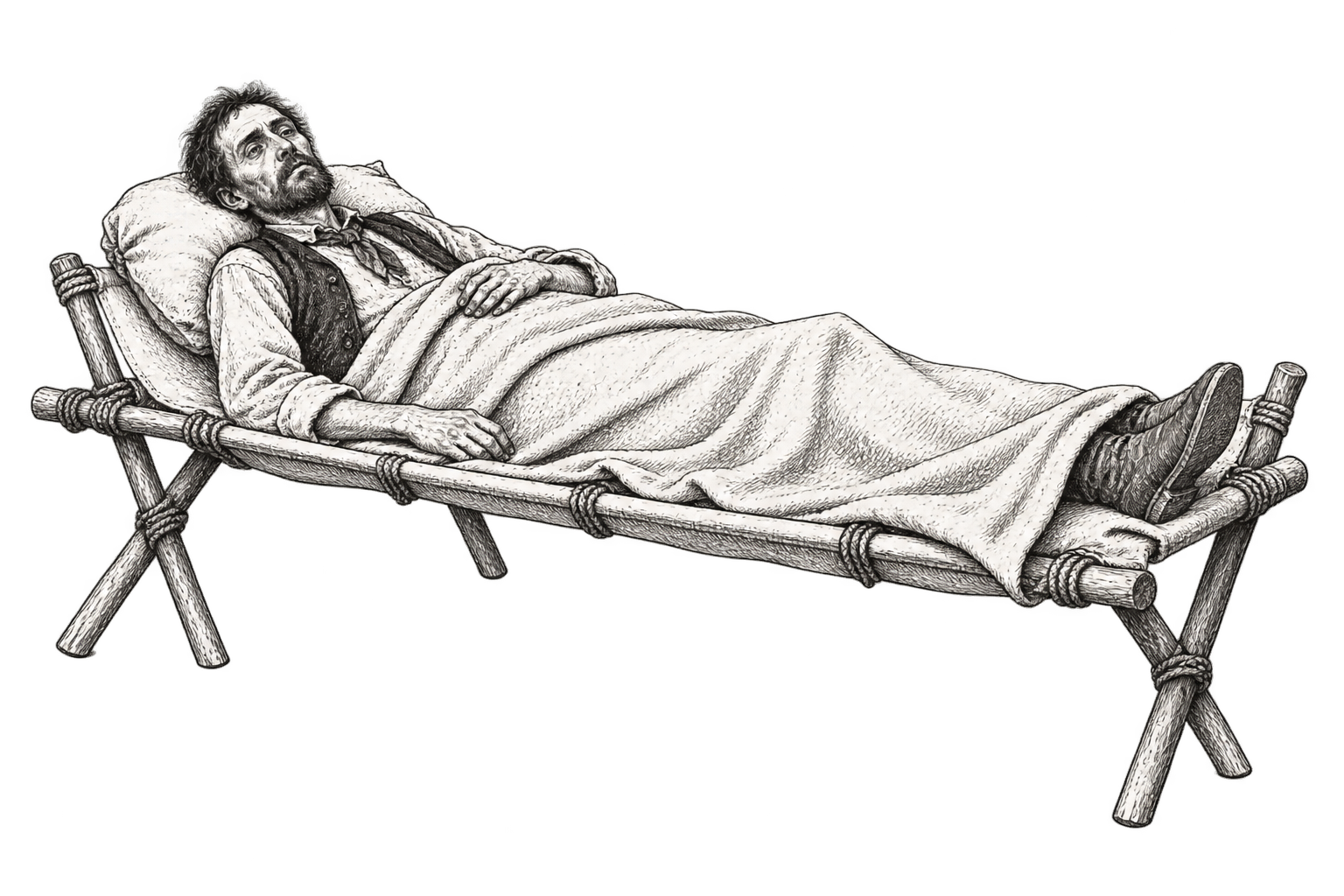


Moya Sharp
Latest posts by Moya Sharp (see all)
- The Angels on the Hill – Some Memoirs of a Nursing Sister - 19/09/2026
- Rafferty’s Rules and Rough Justice at Niagara - 19/09/2026
- Twenty Yards from Water – the man who was lost twice - 19/09/2026
Leave a Reply