By Darren McAullay –
If Rudyard Kipling ever needed inspiration to create a character, he could have looked no further than the Kalgoorlie Goldfields during what was known as the ‘Golden Era’. Yes, the goldfields had a flavour and a savour all of its own, which could hardly be found anywhere else in Australia. It was a place where great human spirit existed, where glamour and romance were associated with joviality and comradeship, where pathos walked hand in hand with tragedy. The goldfields were a gallery full of characters from prospectors to politicians and horsemen. These wonderful men were as much part of the making of Kalgoorlie as the gold itself. Edward Ernest ‘Eddie’ Oates was indeed one of these characters; in fact, the former bookmaker, athlete and football umpire, since his death in 1979 at the age of 94, has become a legend of the colourful Kalgoorlie’s past.
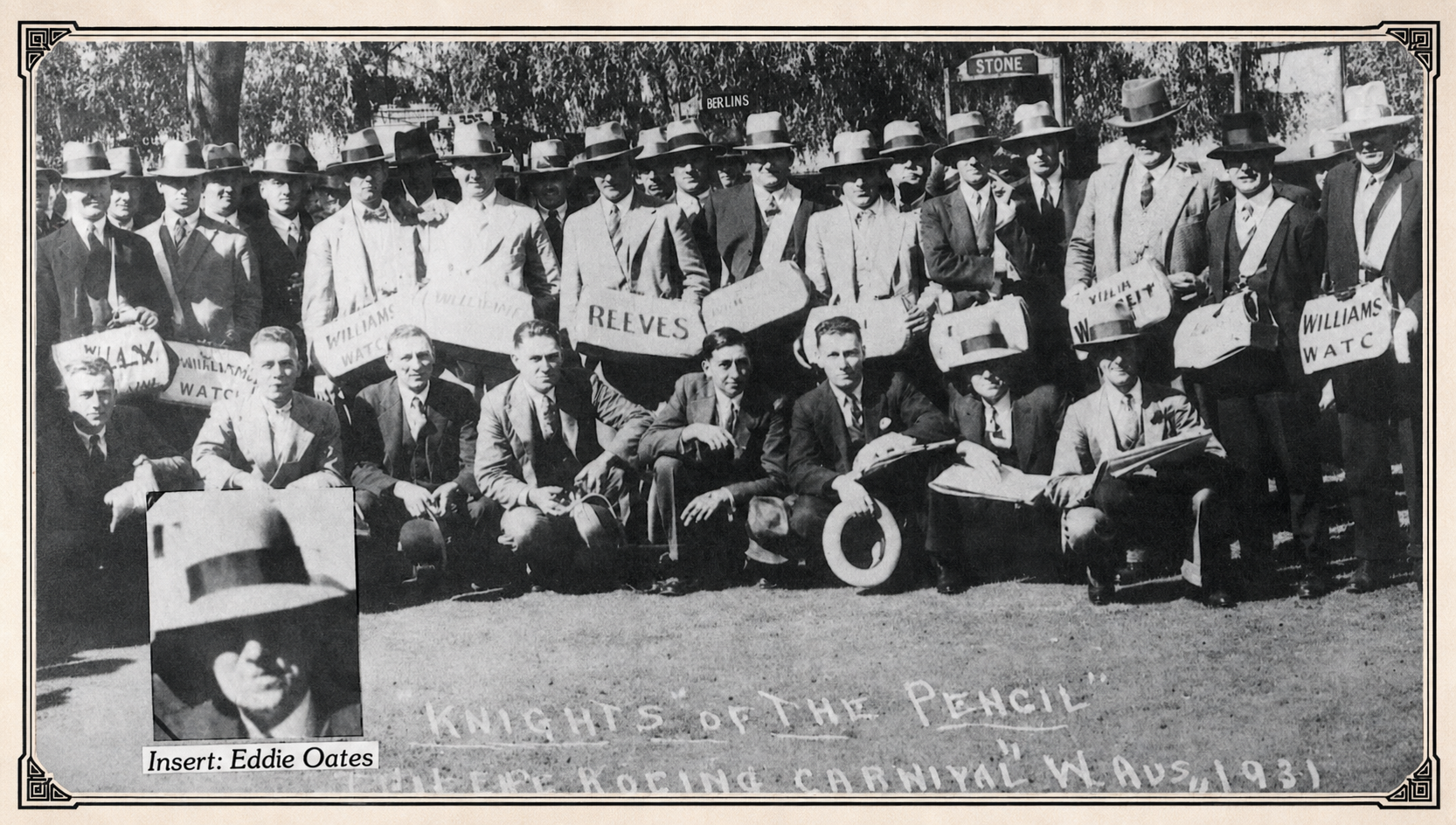
Knights of the Pencil, Kalgoorlie 1931, Eddie Oates kneeling front row second from left – Image TROVE
Oates was born in Eaglehawk, Victoria, in 1886 and came to the West as a child with his parents, William and Rosina Oates and was reared on the famous ‘Dirty Acre’. He started his career as a silver doubles operator and eventually worked his way up to become one of the most successful and respected bookmakers in WA. From the very beginning it was obvious he would carve a niche for himself in the ‘Sport of Kings’, and bookmaking was something that came naturally to him. Before Oates had barely completed his basic schooling, he was already dabbling on the punt.
The 1902 Doncaster Handicap Sydney Cup double provided the youngster with his first taste of success on the turf.
A £45 silver double on the combination of ‘Sir Foote’ and the champion mare Wakeful was the catalyst for Oates to later establish himself as a silver doubles operator on the block near where the Boulder Block Hotel stood. The gambling trade flourished from within Oates’ news agency and tobacconist shop on the busy Boulder block, with many of the miners dropping in for a tip or a bet before charging off to quench their thirst at one of the seven hotels which operated on ‘The Dirty Acre ’. The Dirty Acre was an area of land in the centre of the dusty, dirty, sulphur-laden Golden Mile. Miners who left the acres said they were haunted for years later with the acrid smell of sulphur, the fumes of oil, the smell of stale beer, of cooking from the eating houses or sauerkraut from Otto Leimich’s hotel and the overall reek of sweating human beings.
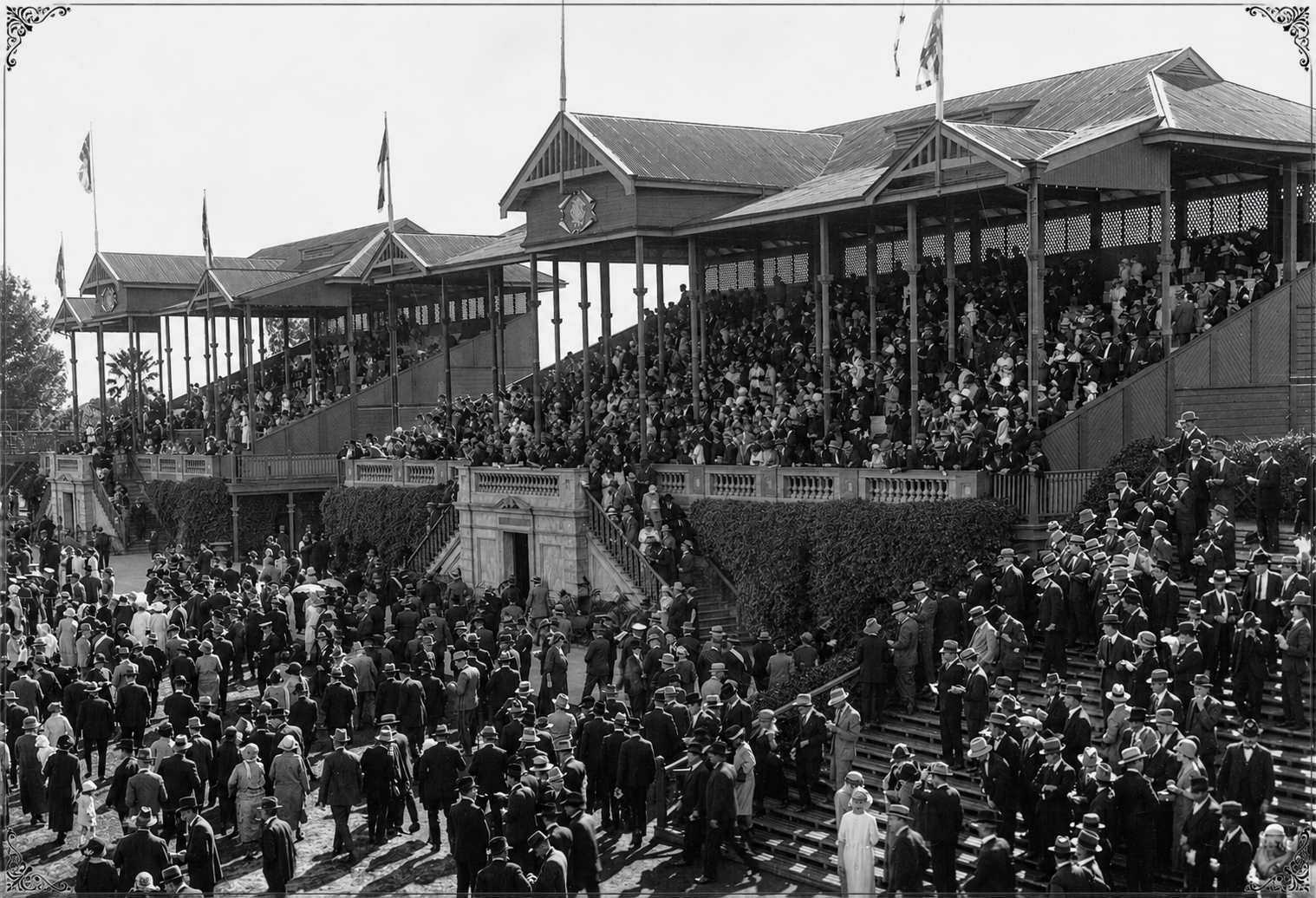
Kalgoorlie Racecourse Grandstand – Image Museum WA
By 1916, after bookmaking at unregistered race meetings at Parkstone, Lakeside and Somerville, the entrepreneurial Oates was granted a licence by the Western Australia Turf Club. For over fifty years Oates dressed his betting board, called the odds and pitted his skills against some of the shrewdest punters in the land before retiring during the 1960s.
Throughout his racing career as one of the state’s best-known ‘Knights of the Pencil ’, Oates did business with the battlers, people of social prominence and, on two occasions, with members of the royal family.
One of his most treasured possessions was a British Exchequer note for £6; it represented a winning bet at 10-1 made with him by His Royal Highness Prince Edward, Prince of Wales, during his visit to the boulder racecourse in 1920. The Prince, who later became Edward V111 and abdicated after only 325 days on the throne to marry American divorcee Wallis Simpson, picked ‘Four Kings’, a logical selection in the Prince of Wales Stakes, a race named in the honour of the royal visitor.
The Prince pinned his hopes on ‘Four Kings’ as its sire ‘Comedy King’ carried the colours of his grandfather King Edward the V11 to victory on numerous occasions on English racecourses. Having decided to at first wager a fiver on Four Kings, the Prince increased the bet to £6 after persuading his aide-de-camp, Admiral Halsey, to have a pound with him. Admiral Halsey stepped forward into the ring and made a bet of £60 to six with Oats. Realising the source of the bet, Oates decided to keep the Exchequer note and paid the Prince in Australian notes.
Fourteen years later, the affable bookie again welcomed royalty to his long list of clients, this time through the Ledger, which had shown a small return. Prince Henry, Duke of Gloucester, who during his 1934 Australian tour attended the Kalgoorlie Boulder Racing Club, did not seize upon the omen tip Royal Durbar in the race named after him; instead, he admitted later to backing two other runners who finished well back behind, you guessed it, Royal Durbar!
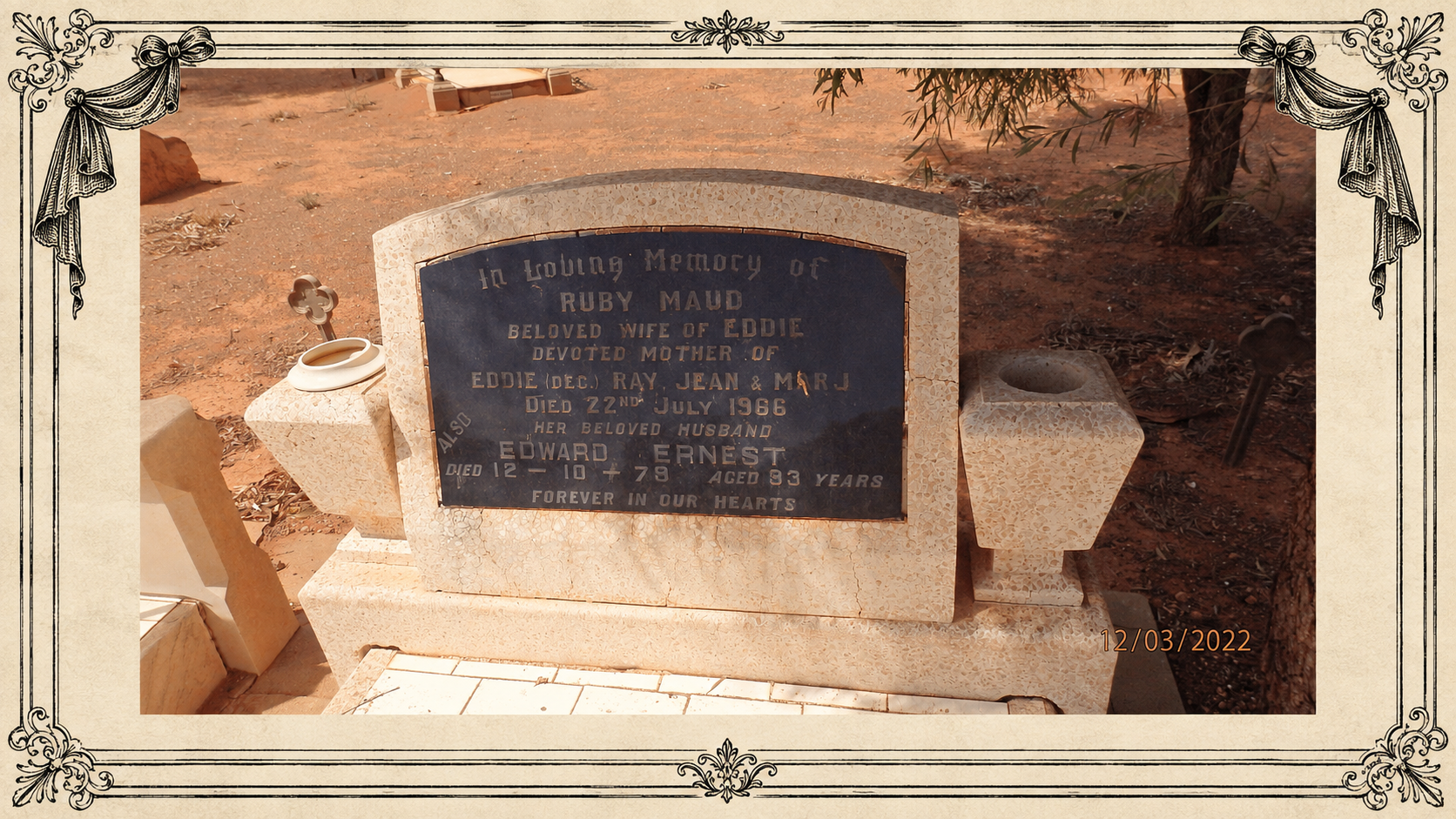
Oates family grave – Kalgoorlie Cemetery – Image Find a Grave
Oates was regarded by many astute racing men of this era as being one of the biggest and the most fearless SP bookmakers in the history of WA racing. Although racing and gambling were his life, Oates only raised and raced a ‘few’ horses during his involvement in the sport. Not that it was ever made public, as he preferred to race his gallopers in other people’s names.
Oates subscribed to the theory that you never gave a mug an even break.
Of Goldfields people, it was once said they portray that wonderful spirit of comradeship, a rich vein of romance and the splendid manhood of early pioneers which adversity or success never altered; in the case of Eddie Oates, one of Kalgoorlie’s most famous sons, how true!


Moya Sharp
Latest posts by Moya Sharp (see all)
- Dear Reader - 10/10/2026
- Doyle’s Well: Coaches, Cold Beer and Frog Cocktails - 10/10/2026
- A Fate Worse than Death – Lost in the Bush - 10/10/2026
A good story I remember Eddie Oates
Was a legend in his own lifetime